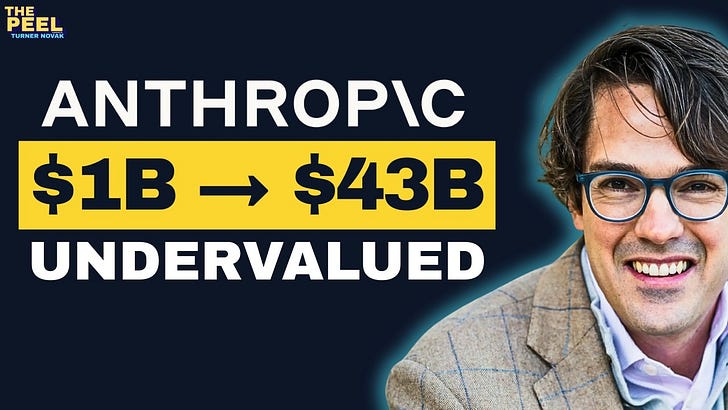
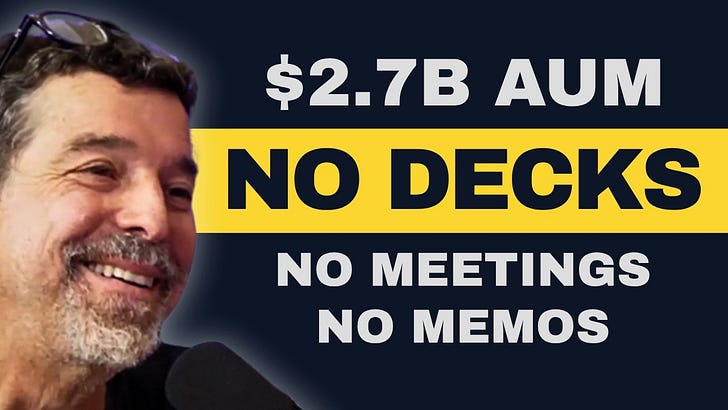
In honor of Anthropic’s S-1 dropping today, I sat down with one of its early investors, Matt Murphy at Menlo Ventures.
Matt sat in Google’s board meetings from Kleiner’s first check to IPO, and he might be the only person who invested pre-revenue in both Google and Anthropic.
While the company is still in their quiet period (and we’re both investors), we go inside Menlo’s pre-revenue, pre-launch Anthropic investment, how they rebuilt Menlo into a top AI firm, when to break the rules in venture, the three LP’s that made over $1B each on the $500M Anthropic SPV Menlo raised without being able to show a single financial, Menlo’s barbell approach to investing, and why today isn’t like 1999.
Support this Episode’s Sponsors
Monaco: The revenue engine for startups.
Flex: Sign-up for Flex Elite with code TURNER, get $1,000 here.
Clerk: Everything you need for authentication.
Numeral: The end-to-end platform for sales tax and compliance.
Inquire about sponsoring future episodes here.
Timestamps to jump in:
0:00 How to read Anthropic's S-1
1:21 Do AI companies actually make money?
2:23 Google didn't want ads. Anthropic didn't plan on enterprise.
4:51 Bending the rules to back Anthropic pre-revenue, pre-launch
9:50 You can't be a leading AI firm without a top model company
12:00 Leading the Series D at $18B six months later
14:22 Why the best researchers chose Dario
15:25 Menlo's first-ever SPV, nearly the size of the fund
16:44 The LP meeting that sparked a $500M SPV
19:18 Raising at $18B without showing financials
20:04 Three LP's made $1B+ each
24:23 Why Matt joined Menlo in 2015
26:00 Rebuilding Menlo over the past decade
32:49 Venture as a team sport
35:45 How to keep a challenger mentality
38:15 Why VC firms decay
41:31 The Anthology Fund: OpenRouter, Wispr, Goodfire
42:27 Ownership vs. backing the best
46:10 Why this isn't 1999
48:06 Frontier vs. open weight models
51:29 The barbell portfolio strategy
53:54 Avoiding the messy middle between early and growth
55:07 How to spot a category leader
57:18 Fortune 5000 AI adoption: "almost none"
59:06 Menlo is in 10 of 70+ neolabs: Skild, Chai, Axiom
1:02:13 Where $1B AI startup raises actually go
1:04:18 Phase 1 vs. Phase 2 of AI
1:06:26 What the AI IPOs mean for venture
1:09:11 What Matt does differently after 25 years
1:10:52 The Alex Smith lesson
Find Matt on X / Twitter and LinkedIn
Referenced:
👉 Stream on YouTube, Spotify, and Apple
Transcript
Find transcripts of all prior episodes here.
Turner Novak:
Matt, welcome to the show.
Matt Murphy:
Thank you. Appreciate you having me.
Turner Novak:
So Anthropic’s S-1 just dropped. Everyone has probably read it or is reading it right now. A lot of people are commentating on the numbers. So what do you think about all the numbers behind Anthropic?
Matt Murphy:
Yeah. Well, I guess they’re still in their quiet period, so I can’t comment a lot on the numbers.
But I think there’s things that you read in an S-1 and you’re like, well, what is operating cash flow? What is gross margin? What is growth rate? I think those are the things that most people really look at as a barometer or indicator of how the company’s performing. And then you have these GAAP charges, like non-cash charges for warrants or convertible notes and things like that.
So there’s been this headline around negative $42 million burned or something like that, and that’s not really a burn number. It’s certainly not a cash number. It’s kind of a non-cash issue. I think there’s just a lot of people who don’t know how to read an S-1, so hopefully there’s some good reporting coming on the metrics that one should really look at to measure the business.
And understand what GAAP tries to do, which is give you a bunch of different dimensions of accounting charges and things like that that are non-cash, and I’d say not really leading indicators of how the business is performing.
Turner Novak:
So if somebody says, “All these AI companies don’t make any money,” and it’s just like a pyramid collapse or whatever, is that not true then?
Matt Murphy:
Well, if you look at the business, a lot of analysts, mutual funds, etc., look at operating cash flow. And they showed that they’ve been operating cash flow positive and expect to stay that way. So I think that’s a more interesting indicator of the health of the business.
That’s why I mentioned gross margin too. There are things that are a little bit more indicative of the fundamentals of a business than accounting charges. Not that they’re not important, but you’ve gotta look at the whole picture and understand what really are the true leading indicators.
But aside from all that, I’m so excited about finally having this flip, because there’s been so much speculation in terms of the business, what it’s all about, what its growth rate is, etc.
When I was earlier in my career, I got to go to all the board meetings from the time I was at Kleiner Perkins when we invested in Google to the time it went public. Still today, people probably think of it as the fastest growing business ever. I think it was zero to a billion in five years, zero to $10 billion in 11 years, or eight years. And then $10 billion to $100 billion in 11 years after that. So you’re talking 19 years to get to $100 billion.
Turner Novak:
Which, even by today’s standards, is still pretty good, I feel.
Matt Murphy:
Oh yeah. It’s tremendous. But then you have a company that comes along and can do that in a third or less of the time. So that just puts in perspective how quickly this company is growing, and what a different phenomenon we’re in with the growth of AI.
Turner Novak:
Were there any other similarities or maybe differences between the two companies, just getting to see them both up close? You’re possibly the only person that’s seen both of them that close.
Matt Murphy:
Yeah. Well, a similarity is, I think when Google started, Larry and Sergey did not want an advertising business at all. So you didn’t really go into it knowing what the business model was. They were going to charge per search query or things like that, and they got thrust into the advertising business.
And I’d say in the case of Anthropic, they knew what the business was going to be, but they didn’t know they were really going to be an enterprise business. They started off just kind of like, “Hey, we’ve got an API, we’ve got a great model. We’ll figure out where it’s best to take it to market.”
But at the time, OpenAI was dominating the consumer interface, or consumer interaction. And they partnered up with Amazon and Google, both for compute, but also for distribution and technology partnerships. That took them down the enterprise path, which ended up being the even faster, more lucrative market to go after, which is how they catapulted themselves to number one.
So those are some interesting similarities. Oftentimes there’s a great underlying foundation or technology, but it’s not entirely clear exactly how you’re going to monetize or what the business path is forward. And I’d say that’s true of a lot of technical founders when they start a business. Certainly both companies were founded by elite and special technologists in Dario and Larry and Sergey.
Turner Novak:
So when you first invested in Anthropic, they were pre-revenue, right? They had no revenue-generating products?
Matt Murphy:
Pre-revenue, pre-launch. At least in the case of Google when we made the investment, you could see the usage was very, very high. They just weren’t monetizing yet. But yeah, go ahead.
Turner Novak:
So how did that go? How did that even come about? Because everyone’s heard these stories that Anthropic couldn’t raise that round. Like, no one wanted to do it. So how did that come about where you guys ended up leading the round?
Matt Murphy:
Yeah. Well, we participated in the Series C and then led the Series D. The Series C is when we participated. We could have led, but the company at the time, like you said, was pre-revenue, pre-launch, at a $4 billion, $4-plus billion valuation.
And I know to a lot of listeners today it’s like, oh, $4 billion, isn’t that kinda common? But if you roll the clocks back to ‘22, ‘23, there were no companies like that. That was a spectacular exit for a company. Literally spectacular in the history of venture if you exited at a $4 billion valuation.
Turner Novak:
And you were coming in.
Matt Murphy:
And now that was kind of the entry point. And then you’ve got issues like, well, what fund does that go in? How does a venture fund do that? And then because it’s pre-revenue and pre-launch, how does a growth fund do that? So it was kinda caught in the middle.
But I’m glad that we had a partnership that was all in on AI and aligned around, hey, this is at least the second best company in the category, the best technical team, and we just have to be in this category. We kinda bent the rules a little bit to say, “Hey, all right, it’s imperfect for either fund, but this is a special team, the team that created ChatGPT.”
The models were benchmarking really well, and it was a massive market. So we kinda bent the rules a little bit to say, “Hey, let’s participate in this round with a goal to lead the next round.” And obviously that worked out fabulously. As soon as we invested, we had a different type of relationship with the company.
We were working with them on a bunch of stuff, be it recruiting, talking to customers, and just a lot of strategic issues that come up early in a company. And then we really saw them put together the deals with AWS and Google, and the revenue flywheel just starting to spin.
Both big, meaty deals where they were saying, “Hey, we’ll come in and help you do an FDE project, a forward deployed engineer to come in and help you build something special with a large telecom,” but also this drip of a long tail of developers. So we saw the company go from zero when they launched in April to, it’s been reported, something like $85 million at the end of the year.
And we saw that happening in September, October, and just jumped on it to be able to lead the round. And I think unless we had made that small initial investment, we wouldn’t have had the relationship to have seen all of this stuff going on, as well as to have earned the trust with the team to be able to lead that round.
Turner Novak:
So when I think about 2022, I did a first close of my second fund in the summer of 2022. Now, that’s not a very happy time or fun time to be raising money. So in terms of all those internal discussions you had, I’m sure it was probably, of all times, a pretty difficult time to say, “Hey, we’re gonna plant our flag in the ground right here.”
So how did those discussions go of taking a really big bet?
Matt Murphy:
Yeah. Well, it started off, like you say, just really difficult, because it didn’t fit in either fund. It was kind of like, what are we doing at four and a half billion? Even if this thing doubled, it’s not gonna be meaningful to the fund.
So these are all the kind of conversations you get into with VC’s. Like, “Hey, it’s not gonna move the needle unless it’s a 10x,” and who’s gonna bet this company’s gonna be worth, let’s say, $45 billion? $40 billion. That sounds insane. That sounds crazy, right? But we’re in new times here.
There’ve been massive exits like Cursor, etc., that came after our investment. But I think the point was, as this AI market was taking off, it was taking off at growth rates that no one had ever seen before. The other technology waves have always been constrained by something, whether it was devices or access to high-speed internet or comfort with your data being in the cloud.
This was immediately for everyone. So you saw all the trends showing that this was gonna be a much, much bigger trend than any that we’d seen before. So it was controversial, but at the same time it’s like, “Hey, we wanna be a leading AI firm. How can we be a leading AI firm unless we find the number one or number two company in the category that is a model company?”
Because the model is basically the heart and soul of this whole AI economy. It’s the brain and the intelligence that helps all the other applications build around it. So from that standpoint, I initially was like, “Oh, my partners are gonna think I’m kinda crazy. Do I really wanna be out over my skis?”
And fortunately, when you have a very aligned partnership that’s willing to dream the dream with you, they’re like, “Come on, Matt. Let’s do that.”
So that was the first investment. And then, like I said, the second investment, where we did the $500 million-plus SPV, was a little bit more like, “Hey, this is much more obvious.” The valuation then jumped up into the $18 billion range, so now we’re talking a whole different quantum. But at that point in time, you’re like, “All right, this company is extremely legit. They’re scaling quickly. Amazon and Google have chosen them as their partner of choice.”
So now you had the OpenAI and Microsoft axis versus Anthropic and Google and Amazon. I know that’s all changed, but at the time, that’s the way it was playing out. So you saw these really important pieces come into place. You saw the model just being frankly better, and them executing really well.
I think Dario’s just always been an amazing technical visionary, and some of the best researchers in the world were all flocking to join the company. So all these advantages were starting to compound. And it’s kind of crazy. The cycle of raising capital used to be every two years, maybe two and a half years. All the things I talked about happened in under six months. Amazon, Google, that revenue going from zero to roughly 100.
So you saw those data points and just felt like this was our one shot to be aligned with this really, really special company. And again, it was great to have a partnership that said, “Hey, we need to do this, because we want to back one of the two main model companies, and this is the one that we think, over time, will be by far the best.”
So anyway, that’s kinda the story, and then off to the races. Since then, none of these things are a straight line. I think how the enterprise versus consumer market played out, finding an absolute hit mega market like coding, and the way it just came out of the Anthropic labs, shows you not only the level of technical talent they had there, but also the creativity and understanding of how to take a great technology and meet the market. And some of those things were starting to become obvious early on.
Turner Novak:
Maybe it’s hard to tell, but do you know what it was that made all the best technical talent wanna go work with Dario at Anthropic? Did he say a specific line, or was there just some kind of a culture there that attracted people? Do you know what it was?
Matt Murphy:
Well, certainly authentic. A true technologist. I think a lot of the best researchers in the world wanna work for somebody who’s kinda like them. And no offense, but Sam’s more of a business person.
Turner Novak:
I’ve always seen him as a deal guy, almost.
Matt Murphy:
Yeah. Okay.
Turner Novak:
I see him as a good deal maker, which he is. He’s done it many times.
Matt Murphy:
Right. Yeah, exactly. That’s his superpower, and Dario’s is building amazing technology and recruiting amazing researchers. So I think it was that. It felt like he was more like them, and they wanted to be part of the vision he had.
I also think Anthropic’s always had a tremendous culture, a low-drama culture, and they have certainly stood out there relative to some of their peers.
Turner Novak:
So then, in terms of how you did this SPV, because I think it’s probably interesting to people. I think your fund...
Matt Murphy:
Our first SPV ever, by the way.
Turner Novak:
And I think your fund was like $600 million. Am I remembering that right?
Matt Murphy:
$750 million.
Turner Novak:
$750 million. And so you raised an SPV that was almost the same size as the fund.
Matt Murphy:
Yeah.
Turner Novak:
So what was that process like? Because I’ve actually heard many people say, “We don’t do SPVs. We’ve never done them before.” Had you guys just never done it? You didn’t see a need for it? How did this come about, and what made you flip over?
Matt Murphy:
Yeah. I think historically, if you look at Menlo, we went from an early stage firm, Seed and Series A, and then we started our Inflection fund, which this investment eventually came out of. That was considered early growth, which we define as $3 to $10 million of ARR. That was early growth, right?
Turner Novak:
That’s like a customer for Anthropic, isn’t it?
Matt Murphy:
Right. Right. Well, and by the way, that’s why our strategy has evolved a little bit. That used to take a year to 18 months, and now that’s like a week for a lot of companies. So that $3 to $10 million range is harder to pursue right now.
Turner Novak:
I feel like some of them are adding $10 million a day now. They’ll publicly say, “We just had a $10 million day.”
Matt Murphy:
Yeah. The last day of the quarter can be a $10 million day now.
Because we had this opportunity to lead, what had actually happened was we had Anthropic at our LP meeting, which was in early November.
Turner Novak:
Was this ‘23?
Matt Murphy:
Yeah. So we had Anthropic at our LP meeting, and this executive came and blew everybody away.
Turner Novak:
It was Neerav, I think.
Matt Murphy:
Yeah, it was Neerav, like you said. Exactly. Kind of a stealth warrior within the company who’s been a jack of all trades, but has really worked on important initiatives.
He was working on the financing and really the big customers they had, a number of things like that early on, when a company’s lean and everybody’s doing a lot. So he came to the LP meeting and absolutely blew everyone away. And our LP’s after were like, “Hey, how do we get in this company?”
Turner Novak:
What did he say? What did he say that blew people away?
Matt Murphy:
I don’t feel like at that point in time people really understood the power of AI, how it was being used in the wild, and what it was capable of. Especially people from all over the country.
And now it feels like, oh, we’re all using it, we all understand. But just like four years ago, a $4 billion valuation felt hard to fathom. So much has changed so quickly that lots of things that we take for granted today were new to us back then.
So I think it was just understanding all that. And he was incredibly articulate and painted this amazing vision for where AI was going and what it was gonna solve. So out of that meeting we had a bunch of our LP’s saying, “This is fabulous that you’re in this company. Can we co-invest with you?”
And before you knew it, there was a couple, three hundred million of interest. And we’re like, “Oh, we’ve never done an SPV before, but this is a special company. We wanna lead the round.” But the round’s gonna be pretty big. We can’t do it out of our $750 million fund. We can do 50 or 100 out of that fund, but we can’t do the rest.
So we said, “Hey, how about we take capital from our fund and our LP’s, put this whole thing together, and make a proposal to lead the round?” And as history would have it, we were definitely a little over our skis at the time. You get a lot of people interested, but when you go and shake the trees, some things fall out of the trees and some don’t.
So there was a scary period there for about 30, 45 days where I was like, “Oh my God. I think we’ve over-committed here, and we may not pull this off.”
Turner Novak:
So are you just texting everybody, like, “Hey, this is going on”?
Matt Murphy:
Oh, we did a couple of webinars. But it’s funny. What I didn’t realize when we raised the SPV: we were very collaborative with Anthropic, and they were supportive of it, but they said you can’t share any financial information. And so I’m like, “Okay, fine. People are just gonna believe the dream as much.”
We could take publicly released things that gave us some product slides, but you’re asking people to invest at an $18 billion valuation, and you can’t show any financial information. I think we could say what last year’s revenue was, but we couldn’t do any forward projections.
Turner Novak:
Wow.
Matt Murphy:
So that’s kind of a tall ask when you’ve got big state pension funds and things like that. We did a couple of webinars, and then we did a bunch of one-on-one follow-ups. But there were a bunch of people like, “Look, we just can’t responsibly do that as a state pension fund.”
But I can tell you that three did, and they’ve all made well over a billion dollars at the last round valuation. So all in, this is a pretty amazing return. Fortune favors the brave, and we’re glad that we had some LP’s that came along the road with us.
But it wasn’t what maybe you would expect in hindsight, because things have always been unclear, and then they get clearer as the company’s grown and shown what it’s capable of. But we got it done. I think we closed in two tranches, with the last one in April.
Turner Novak:
So you did have a little bit of time to land the plane. It wasn’t like a one-week thing.
Matt Murphy:
No. We signed the term sheet in mid-December, and then we didn’t even really start the process until January. Let’s say we had everything firmed up by March, and then it all closed, last close was early April or something like that.
But it gave me a lot of empathy for entrepreneurs raising capital, because essentially what I and one of my partners became was basically the capital raisers for Anthropic. Not that they really needed it, because if Dario got in front of anybody, or that team, Tom Brown, all of them, they would’ve had a much easier time than I did.
But we committed to raise the capital, and so we were out there talking to LP’s and saving them the time of talking to a bunch of institutions, so they could focus on the thing they’re really good at, which is building amazing technology. And I’m glad it worked out.
Turner Novak:
When you’re in there raising the money yourself, and people are just like, “Yeah, I’m not that interested. This doesn’t seem that good,” it just hits you in the face over and over again. You’re putting your name on the door, putting yourself out there, and people are saying no.
Matt Murphy:
Oh, yeah. Some of our biggest LP’s, who like I said have made well, well over a billion dollars, so it’s great that we were right. But it did feel at the time like a potential existential moment for the firm. If we were wrong, losing state pension money, or not leaving our best LP’s in good graces with us, would be a really bad thing.
But a big swing always has those dynamics about it. So I’m just thrilled that we were able to do it. We knew this company was gonna be big and special. We just didn’t know quite the quantum of what that would be and how fast.
Turner Novak:
Yeah. Well, talking more about Menlo more broadly. So are you guys 50 or 51 years old?
Matt Murphy:
Turned 50 in November.
Turner Novak:
Okay. Well, then you’re almost 51 at this point. It’s already almost November again.
Matt Murphy:
No, no. This year we turned 50.
Turner Novak:
Oh, you’re turning 50.
Matt Murphy:
Turning 50. 2026, yes.
Turner Novak:
Oh, got it. Okay. And you joined about 11 years ago. So of all the places you could’ve gone, why did you pick Menlo?
Matt Murphy:
Yeah. Many reasons, but one easy one was that one of my closest friends from business school, Mark Siegel, had been handed the keys to take over the firm from the founders. And generational transition is really, really hard. It blows up a number of firms. It slows them down. They miss technology waves. It’s one of the hardest things in venture, and Menlo did it beautifully.
Beautifully in the sense that they handed the keys to Mark and said, “All right, Mark, you go do this.” And then Mark did an amazing job to first get Venky and then me. Shawn Carolan was off running a company, and we recruited him back after about a year. So that was the band that came together. And then Mark retired about three years after that. I guess he figured his best work was done, to get us all together.
So it just felt like, after being in the business for 15 years, to come in and really have the opportunity with an almost 40-year-old firm, a great brand, a long-standing firm with a reputation for being in a lot of amazing companies. They’re a group that always does the right thing. Those are the reputational things that you want.
But I think at the time we were also missing a bit of edge. How hungry is Menlo? Is Menlo everywhere? Do you feel Menlo in the market? Are they early stage? Are they getting there before you?
Turner Novak:
Were people saying that you weren’t doing any of those things?
Matt Murphy:
Well, I think that was just our internal critical observation. The firm had gotten much bigger, to billion-dollar-plus funds, and part of bringing it down to the studs with me, Mark, Sean, and Venky was to say, “Hey, we’ve got a single $400 million fund. We’re gonna go back to early stage and rebuild from there with a smaller team.”
And all of what you see today has really been brick by brick since then. We added an early growth fund because we felt like at that point in time there was this wedge in the market. You had growth that was like $10 million and up, and then you had early venture, but the momentum companies in the middle weren’t really that covered.
Turner Novak:
This was the $3 to $10 million run rate, right?
Matt Murphy:
Yeah. And I’m talking back in 2016 to 2018. The venture and growth markets were a little bit more bifurcated, and now everything’s blurred a lot more. But that got us into the early growth business and allowed us to get into a number of high-velocity winners. It allowed us to double down on a company like Anthropic and continue to do that round by round.
I’ll give you another example. When I joined the firm, we didn’t really have any services team. At the firm I came from, Kleiner Perkins, we had a pretty big services team. We polled our entrepreneurs and our network of people in the industry: “What are the two or three things you really care about from your venture capital firm, your partner?”
It was, “Well, I want a really great partner who’s there and does the right thing in up and down times. Super solid, trustworthy, doesn’t whipsaw around. Just a great advisor on the things that really matter.” So check. I think we’re all wired that way. And then after that it was, “Hey, I want people who can help with talent and deals.”
We didn’t have any of that, so I brought over a guy named Jordan Ormont, who I worked with at Kleiner Perkins for eight years, to build out our talent function, which now has three people. We hired a person named Houman out of Qualcomm to come over and run our biz dev function. We run a lot of EBCs. Any customer you wanna get to, talk to Houman or Bryan, who’s on his team.
So we looked at the market and said, “What is Menlo doing today? What is the market expecting? How do we fill in that void?” Tactically and strategically, we needed that to be a more competitive firm.
Then there was, hey, there’s a lot of high-velocity companies in that $3 to $10 million range. We can’t play in that market because the fund size isn’t big enough and we’re doing early stage venture, so let’s add that.
And then, I’ll roll the clocks forward a little bit, you get into things like, hey, this new technology wave is coming. We sat out crypto, we sat out VR, thankfully.
Turner Novak:
Those are probably some good moves.
Matt Murphy:
Yeah. Crypto money was made, but in terms of real businesses and so forth, there’s a lot of trading companies, things like that. It just wasn’t for us. We can’t be all things to all people.
But as soon as the AI wave started to come along, we were like, “This is our moment. We have incredibly high conviction inside the whole firm. We’re just gonna put all our chips on the table on that.”
Turner Novak:
And so what period was that? What kind of year?
Matt Murphy:
It was shortly after the launch of ChatGPT. So what are we talking about? 2022, roughly that timeframe. End of ‘22. Maybe six months before we funded Anthropic.
And we were the first firm, I think, to put out something on the AI infrastructure stack. Every time a technology wave comes along, there’s some new infrastructure stack that comes out. So we put out this market map, and we did it for our own internal thesis work, to guide where we thought we should be investing. That’s the way we are: a very thesis-oriented, thematic firm.
And then you start saying to yourself, “Hey, this wave of even applications...” If you look at SaaS applications, there wasn’t really a lot of technology under the hood. You had to build some things efficiently, but you used Amazon, and you were building really cool workflows and interfaces and things like that.
Now, if you look at all of these companies, whether it’s something like Legora, which we’re an investor in, or Lovable, etc., there’s huge amounts of technology under the hood. So we felt like the investors who thrived in the SaaS era were not as technical as those that were needed to thrive in this environment.
And that example was even on the application front. If you look at the infrastructure front, same thing. So we hired Tim Tully, who was the CTO of Splunk for a long time. Cisco bought them for $20 billion, so obviously a very successful company there.
Joff Redfern, who was the chief product officer at Atlassian. Matt Kraning, a PhD in machine learning from Stanford, who sold his company to Palo Alto Networks. Deedy Das, who was the founding PM and engineer at Glean. Amy Wu, who had been in venture and at FTX, interestingly.
So all this team came together over a period of three, four years. Much more technically oriented, and they understood developer communities, things like that, that are really flourishing right now.
So if you think about all the bricks that had to come together: we had to have a fund that could invest in a company like Anthropic at their stage. We had to have a prepared mind in the thesis work to say, “Hey, here’s what we’re looking for and why.” We had to have the services team to help add value, because companies would say, “Hey, why do I pick Menlo?” And then the thesis work that I described.
All of that has compounded to be a real advantage. I don’t think it would have happened if Anthropic had just shown up and we were like, “Hey, this company’s great. They created ChatGPT. Let’s do this at four billion.” It took all of this. It took a team surrounding us to give us the courage to do it, the technical work that we’d done, and the ability to win, because they were like, “Look, Menlo seems like a great firm. You have all these things behind you.”
So every journey is not a straight line, and ours was very intentional, putting all the bricks together. I’m really proud of how it’s come together, and even more so about what’s ahead.
Turner Novak:
Yeah, you were telling me that the most fun you’ve been having is actually the team building side of it.
Matt Murphy:
Yeah. Venture can oftentimes feel like an individual sport, and I think we’ve always tried to practice it more as a team sport, because it’s more fun to do it that way.
I think it’s more helpful to entrepreneurs, because you get the whole team, different people who can provide different things. Joff Redfern, former CPO. Tim Tully, former CTO. So we’ve got a lot of people on our team that can help in any situation. And not just help the portfolio companies, but help me.
The reality is, even on the Anthropic investment, I felt highly, highly convicted about it, but it was Tim who went and spent a lot of time with Tom Brown to say, “Okay, I understand this compute multiplier thing, what they’re doing, why they’ve been able to build these really powerful models at a much lower cost, and why we think that can compound and is an advantage over time.”
There were things like that. Otherwise I would’ve been making it more of an intuitive people decision. Like, I just feel it. I feel like this is the one, the market. And then when you can back that up with somebody who has been the former CTO of a $20 billion company saying, “No, this is special technology,” that made my life a lot easier, and made sure I’d done my homework as much as one could.
So like I was saying, it can feel like an individual sport at times. We play it as a team sport. But also, at the stage of my career that I’m at, having been in the business for over 25 years, it created a new challenge and opportunity for me.
To feel like we were building more than just an investment track record, but a set of people that were really proud and happy to work together, and more productive working together. Seeing the firm rise from where we started, with all the things I mentioned, our challenger mentality, and getting up into one of the top handful of firms in this wave of AI, which I would say that we’re at.
That’s more gratifying than the next incremental investment by far. And I think that gives us the opportunity to work with even better entrepreneurs, to have a bigger impact, to have a higher win rate, to have higher access, all those things that matter.
It’s all compounding, and so it’s energizing. You were grinding away for 11 years to get to this point, and if any of those pieces I mentioned along the way didn’t happen, maybe we never would have gotten here. Especially and including that initial decision on Anthropic. It’s been so seminal to our success as a firm.
But then you wake up every day, not with paranoia, but more like, wow, we’ve worked so hard and done so many things to get to where we are now. How do we build on that? How do we take even more advantage of that? No one is happy resting on our laurels or feeling like we’ve arrived. It’s like, now we’re here, and how do we make this an even bigger deal and do more with that opportunity? That’s what’s completely exciting and exhilarating.
Turner Novak:
So when you say the challenger mentality, it feels like you’re trying to continue to carry that forward. So what is it? And maybe another way to think about it is, what is not having a challenger mentality?
Matt Murphy:
Yeah. I would say the challenger mentality when I started 11 years ago was, hey, there’s a big gap between where we are now and where we think we want to be. Not necessarily in reputation or principles or who we are as people, but how we’re perceived in the market. The things we’re in the mix on, our ability to win, our ability to have an impact with entrepreneurs, all those things. There was a gap.
So that challenger mentality was, we’re going to fix all that. You can’t flip a switch, so that’s the long journey.
Now the challenger mentality is a little bit different. It’s not going from here to here. It’s like, all right, now that we’re in this cluster of really great leading firms, how do we continue to compound that as an advantage? Instead of reaching to get there, now that we’re kinda there, it’s how do you not lose that position? Because there’s no telling when you’re gonna find your next Anthropic.
So it’s, well, what else are we doing to continue to build the team, compound the reputation, and show why entrepreneurs should work with us? That’s just the mission every day.
So it’s a bit of a different challenge from when you feel like you’re climbing up the hill. I don’t feel like we’re at the top of the hill at all, but I feel like we’ve come such a long way, and now it’s more about making sure that we continue to capitalize on where we’ve arrived.
And that often starts, and our business starts, with convincing entrepreneurs that you’re the firm they wanna work with because you’re different. You’re more fun to work with. You’re better to work with. You add more value. You ask the right questions. You don’t bother them. You do the right thing in hard times. Those are the kind of values that we wanna take forward that will compound for a long period of time.
Turner Novak:
I’m asking this because you’ve been doing this for about 25 years. If you look back, there’s always these firms that kind of fall off. It’s always happening. You guys displaced someone when you went on.
Matt Murphy:
Believe me, we’ve all seen it.
Turner Novak:
Yeah. And I think you first got into this in 1999, am I right? So have you seen any common patterns of what tends to lead to this kind of decay?
Matt Murphy:
Yeah. I think it’s poor handling of generational transition.
Turner Novak:
So how does that usually go, in a bad way or a good way?
Matt Murphy:
Oh, a bad way: people hang around too long and younger, talented partners leave.
Turner Novak:
So the guy who would’ve brought in the new hot founder goes and starts his own firm, or goes somewhere else, and you don’t even see him.
Matt Murphy:
Right. You kinda lose your younger generation. Or let’s just say you don’t have as much alignment in the firm.
I’ll keep saying this, and it probably sounds like a broken record, but some of the best decisions we’ve made are because we’ve had incredibly high alignment within the firm to do something that at the time felt like, “Why are we doing that? It’s a little bit off-spec for us.” But we were so aligned, a high-trust organization.
If you don’t have a high-trust organization, if people are fractured and doing their own thing, when somebody comes in with an exception like that, it’s like, “That’s not what we do.” So you start creating false guardrails. A lot of things can start to break down like that when you don’t have alignment within the firm.
That’s just one example. I think a lack of generational transition can lead to that. But frankly, a lot of those dynamics can happen in a firm even if it’s not a generational issue. People are practicing the business too much as individuals, and you’re not getting that collective strength that makes you better as a firm.
I think also a massive one is what we already talked about: missing a technology wave. If you were late to the AI game and you weren’t a top firm, I don’t know how you recover. And if you’re a top firm, you can recover because of your reputation, but you’re playing catch-up.
So I think those are some of the many stumbling blocks that can happen within firms. They’re always out there facing firms. It’s not an easy job, for many reasons.
Turner Novak:
Well, one hard one was sitting out of crypto or Web3. I had many people tell me, “Oh, you gotta get into Web3. You’re missing out.”
Matt Murphy:
There was a lot of fast money made.
Turner Novak:
It’s so hard.
Matt Murphy:
And a lot of money lost.
Turner Novak:
Yeah. So what do you think you have to do in order to have a culture that can do that? How did you guys think through it, and how do you define that we have this culture that allows us to make these decisions that are maybe hard at the time?
Matt Murphy:
Yeah. I think some of it just started a little bit serendipitously, where we just did it. Like, “Hey, Matt just really felt passionate that we had to be in this company, so let’s make an exception.”
And then you see some of the exceptions that you look back on, and you’re like, “Oh, well, we didn’t have ownership. That’s a waste of time.” It’s like, well, actually, we didn’t, but we leveraged that into a follow-on investment.
I’ll give you another example. We started this thing called the Anthology Fund in partnership with Anthropic after we led the round. It was $100 million carved out for startups, where we do between $100k and a million, roughly, just to give us a broader aperture. Because it was hard to tell at that time what was gonna be big and what was not. Which application areas, who knows, which areas of infrastructure.
So it really gave us a much wider aperture on a much broader set of companies, to see which ones started working. That strategy led to OpenRouter. Our first investment was $100k in OpenRouter.
Turner Novak:
Oh, wow.
Matt Murphy:
And you read about the rumored $8 billion acquisition by Stripe. That led to Wispr, which has been the leading dictation app.
Turner Novak:
Just the voice-to-text?
Matt Murphy:
Right. Yeah. Multi-billion dollar valuation. Goodfire. Four or five really valuable companies came out of that strategy.
So I think it was about creating some flexibility to open up the aperture around a new technology wave, and not be narrow in thinking around old thoughts, like “a venture firm doesn’t invest at this valuation” or “if you don’t have a certain ownership, it’s not gonna move the needle.” I can go down the list. So many of those exceptions led to where we’ve been able to get to as a firm.
And now we’ve institutionalized it more. As part of the fund, we’ve got full slots, and then we call them exception slots, or stub investments, where you start with a smaller investment, hoping that it gets bigger later, instead of being very religious or dogmatic about needing to own a certain percent at that time.
Because sometimes, frankly, even if you’re a great firm, you may lose. And let’s say you lose. Would I rather have something in to build a relationship, or just say I lost and I’m not gonna do anything, because if I can’t own 10, 15, 20%, I’m not doing it?
So I think you have to be really thoughtful about being behind the best entrepreneurs and the best companies. You can’t go wrong in this business if you’re behind the best entrepreneurs and the best companies, so find a way to do that.
Turner Novak:
A lot of the discourse gets caught up on the math and the ownership. And they’re 100% right that you do wanna own more versus less. But again, do you wanna own more of something that’s not worth anything, or own a little bit of something that’s worth a lot? Obviously you know the answer to that one. So I guess it’s finding the happy medium.
Matt Murphy:
Yeah. You can’t do all exceptions, or you’re gonna have a fund of just a scattered set of things where you don’t have any board seats, and you’re not building that reputation as the investor people really want on their board.
Those are the times where you get more ownership. And unless you’ve proven yourself to be worthy of that, you’re not gonna be able to lead the next round. So you have to have clear examples of how the firm operates in both situations. Super important.
Turner Novak:
And I know one thing you were telling me is that you’ve changed your mind a little bit on the size of the outcome. 25 years ago, a billion-dollar outcome was like what Anthropic is today. That was the max. You don’t get any bigger than that. How have you evolved your thinking around how big companies can be and how fast they can get there?
Matt Murphy:
Yeah. Well, it helps when you’ve got companies growing from one to 100, a billion to 10 billion, all these kinds of numbers. That just tells you that something’s different. Sometimes we have to speculatively ask, “Is there even a market here? How big is it?”
The great thing about this is there’s enough existence proof around how quickly some of these companies are growing, and the outcomes we talked about earlier, whether it’s Cursor or OpenRouter. Look, I’ve been in this business for over 25 years, I’ll say that again too. Never have I invested in a company, not even close, where 14 months after investing, the company’s being acquired for a rumored $8 billion or whatever. That just doesn’t happen.
So times are different. I was around in ‘99 when it all collapsed, and I can tell you this feels dramatically different, given the scale and quality of the business models and who they’re selling to. Sticky enterprise customers, applications that would be really hard to rip out, etc.
And some companies need to work a little bit on their gross margins, but that’s a longer conversation about open weight models and all those kinds of things.
Turner Novak:
Yeah. Maybe we should talk about that. But in terms of the parallels with ‘99, was there anything that was happening in ‘99 that maybe wasn’t obvious at the time, but is obvious now, that’s not happening today?
Matt Murphy:
Well, I think with ‘99, you had a much narrower set of people doing new things that were making things take off and explode, but on a relatively low percentage of the population. And I think that’s one of the reasons why things hit a wall.
What I mean by that is, think about the internet browser. How many people had great broadband? How many people had PCs, things like that? It was highly uncomfortable to use your credit card. So you had some small set of the population that had those things and could get over that, and could help these companies get off to a fast start. But then you didn’t get the next 98% of the population.
Turner Novak:
So we kind of plateaued, in a sense, in a lot of ways?
Matt Murphy:
Yeah. It’s not that it was a false positive. But I think if you could have more easily gotten to the next 98%, or even the next 50%, then the scale of the businesses would have caught up and helped them fix their gross margins and things like that.
But it took too long to get there. And the beauty, as we said earlier about AI, is it’s immediately available to every consumer, every enterprise, everybody. So it’s just a totally different dynamic.
Now, that said, I think it’s more than that. This wave has proven to have good, durable business models, like I said, selling to enterprise customers. There was a lot of ad swapping and just really poor business models back in ‘99. But if I really look back on why things hit a wall, it was the combination of not having durable business models, too small of a population, and not enough time to catch up to that at scale.
Turner Novak:
Maybe an interesting segue: you mentioned the open models. There’s a discourse now that nobody’s gonna use these frontier models anymore, and you should use open source models for everything. I see people saying that. It seems like that’s not necessarily happening, maybe just a little bit. But where do you think that settles out? Is everyone gonna continue to use the state-of-the-art frontier models? Are people gonna use open source?
Matt Murphy:
And then you have the Jev wave, which is an alternative to models. So I think what’s basically happening is, as companies mature, everybody’s built their harness of some kind. And they’re figuring out within their harness what the best model is to serve that application, that part of the application, that query, that agent, etc. And that just makes sense.
At scale, when you get so big, you start to turn the knobs. The first part is just, “Do I have an application anybody cares about? Let me just make sure it’s awesome. I don’t care what it costs, because I just want it to be awesome.” And then you’re like, “All right, now it’s definitely awesome, but my gross margin isn’t that great. So how do I fix that part?”
So you go down that path and do a lot of testing, and say, “Well, if I use frontier intelligence for 70% of the application, what’s the outcome? If I use it for 20%, what’s the outcome?”
So I think the narrative over-corrected on, “Hey, it’s all about open weight models.” And now you see people walking that back to, open weight models are great for some set of tasks, but frontier intelligence just really, really matters. When you have that, it can make so many applications so much better that it’s worth paying for it.
Because what do consumers want? A great product. And if you give them a bad product, they’re gonna go look for a really good product from somebody else. So you can’t compete by providing an inferior quality of product or inferior intelligence. You just have to figure out where it matters and where it doesn’t.
So all that turning of the knobs underneath the harness is where there’s a lot of expertise going on right now. What do I think it looks like? I don’t know. I think it’s probably over 50% the main foundation models, like Anthropic. It’s probably somewhere in the 20, 30% range for open weight models, depending on your application.
But there’s other things happening too. Caching is becoming a lot more predominant, so now the harnesses can catch a lot of the requests and serve them from cache instead of from the model. So there’s a bunch of other techniques that can bring cost down. And then you’ve got something like Jev, and we’ll see how big that can become.
But it’s just natural stuff. People are always optimizing their infrastructure. We’re talking about the model layer, but there’s a bunch of optimization going on underneath the models too. Like a company where my partner Tim’s on the board, Gimlet, where you try to figure out the right underlying GPU to serve that request.
It’s not even about which model. It’s which GPU. Is it NVIDIA? Is it AMD? Is it a TPU that’s best to serve that? Which stack? Sometimes it’s based on availability, but oftentimes it’s based on the per-token cost for that type of query and that intelligence. Same thing that OpenRouter was helping people work on: how do you figure out the right model for your query?
Turner Novak:
So then where do you invest today? I know you talked a little bit about how you do smaller checks at Seed, and then you deploy maybe a little bit later. Are there certain areas you think make a lot of sense? And I know you’ve mentioned before that you don’t think Series A is a good spot. Maybe you can explain.
Matt Murphy:
Well, no, I wouldn’t say that. We’re definitely doing Series A’s for sure. I think what I meant is we’ve taken a little bit more of a barbell approach right now.
This is never static. Remember, two years ago we were doing more early growth, the $3 to $10 million, and then that segment shrunk. So on the growth side, and I’ll come back to early, whenever you have a big technology wave like this, there’s a set of early leaders that continue to compound and be the leaders down the road.
We talked earlier about Menlo’s investment in Uber. That was one of the formative applications around mobile, along with Airbnb and Spotify and Square and things like that. You roll the clocks forward, and the companies in that first wave that cracked a significant use case are the ones that have stood the test of time. AWS, etc.
So what we’ve thought about is how do we identify those in this technology wave? Which is why you see us in Lovable, Legora, Suno, Higgsfield, OpenRouter, and Anthropic obviously, and on and on. It’s like, “Hey, let’s make sure. This is a unique point in time. These winners are likely to compound in an outsized way for a long, long period of time, and we wanna make sure we’re in every one of them,” every one that we think has a great entrepreneur, etc.
So that’s one strategy. And then the earlier strategy is really more like, “Let’s go earlier, let’s do more Seed.” Not just the Anthology Fund, but real Seeds, ownership Seeds. Spend more time at places like Stanford, in the technology labs, things like that, where a lot of these researchers are coming out.
And as an aside on that, nobody really spent a lot of time tracking down researchers 10, 15 years ago, because they were just generally not great entrepreneurs. And now the researcher is king, or queen, as entrepreneur for a lot of these companies. It’s been a great wave to see that whole pool of talent really lead this next wave as entrepreneurs.
But what I’d say we’ve done less of is there’s a messy middle right now between Seed, Series A, and later stage growth. And why it’s messy is because companies can start so quickly now, there will be many of them. They’re all gonna grow really quickly initially. You might have a false positive around a company.
There were tons of competitors going after Lovable’s segment, and then Lovable pulled ahead and became the household name in its category. You could have easily made a mistake and not been in Lovable and been in something else. And you can go through different categories where that’s true. Or maybe there’s a category like legal, where there’s Legora and Harvey, and there’s two leaders and a bunch of other companies that don’t matter, because they’ve taken all the oxygen out of the category.
So basically, get in early and believe big in a market, and hope you can build the company, hope you’re right. But that messy middle, where you’re gonna pay a very high valuation for a company where it’s entirely unclear whether it’s the leader or will be the leader, is just a tricky spot right now.
I’m not saying we won’t do it. It’s just that that used to be our sweet spot for growth. And now we’ve said, “Hey, let’s do more barbell.” We want early technology projects and later leaders.
Turner Novak:
So what do you look for when it’s flipping to, oh, they’re a leader now? Is there something, or some things, that typically are a tell for that? Is it just the growth rate?
Matt Murphy:
Well, certainly growth rate’s part of it. I think there’s validation that there’s a really significant market there.
Turner Novak:
So how do you gauge that?
Matt Murphy:
Probably by their customer diversity. They don’t have some huge customer concentration, where they’ve sold to the two labs or two Fortune 500 companies and gotten two $10 million deals. They’ve got a long tail of significant revenue.
But certainly growth rate is a validator of the market as well. You just gotta feel like, “Hey, look, this product is clearly very, very different than the last wave of product that was serving this market,” or this market didn’t have a product before, and the time to close a deal is very short. Something’s just going on there.
And legal’s a good one, because legal is a terrible area to sell software. And then you start selling something like Legora, and you’re like, “Well, sales cycles are ridiculously short. Deals are fast, and usage rates are crazy high.” That’s probably telling you you’ve got a big market.
But I think even earlier on, you just start to see some dynamics. Like, wow, sales quotas per salesperson are not the normal, “Hey, it’s 1.2 to 1.5 or 1.8 for an enterprise sales rep.” Enterprise sales reps are closing $3 to $5 million of business, or this thing’s just being pulled, more PLG.
So you start to see things like that happen early on, where you can extrapolate from that. Versus saying, “Well, we had to add one salesperson with a $1 million quota to sell this, and then we added three more.” The physics of that are very slow. The real outlier, standout companies now are growing most often through PLG, but also through ultra-efficient enterprise sales.
Turner Novak:
Yeah, I think Anthropic is the king of that. It’s insanely surprising how big the enterprise relationships are. I think there’s a number in the S-1 that said two customers were 25% of the revenue or something. You can charge a billion dollars to one customer. It’s like you used to only be able to maybe do that to the government.
Matt Murphy:
Right.
Turner Novak:
And when I think of what those customers are paying Anthropic for, there are probably a lot more customers out there that are gonna be paying a similar amount of money.
Matt Murphy:
Yeah. It just shows you the value of the technology. And if that happens at some large company, you’re like, “Well, why isn’t that happening at many more large companies?”
Probably just because they haven’t tried it out enough. They haven’t enabled their organization to do it. They haven’t re-platformed all their existing applications. And that’s why, not specific to Anthropic, but if you think about this market and how big these companies have become in such a short period of time, and then you look and you’re like, “Well, wait a minute. How penetrated is the technology in the Fortune 5000?” Almost none.
Okay, so they’re doing some coding and some productivity. How many of them have really re-platformed their whole application stack? Nobody. We’re just at the very tip of the spear on all the re-platforming, and all the new internal productivity apps that all these companies are going to build out, and just their comfort level and understanding of AI. So the whole next leg of this wave is spectacular as well.
Turner Novak:
Yeah. It’s always surprising to me when somebody says that AI is kind of overrated, or they don’t really get it. And I’m like, “Oh, so what do you use?” “Oh, we use Copilot or something, in Word.” Like, well, that’s why. Come on.
Matt Murphy:
Exactly.
Turner Novak:
And so there’s the Anthropic revenue chart. You look at that and you say, “Okay, let’s invest in the next Anthropic.” There’s a bunch of these neolabs, as people call them. It’s basically, okay, we’re gonna do exactly what OpenAI did, we’re gonna do what Anthropic did. I think there’s over 70 of them. I think 77 was the last number.
Matt Murphy:
Probably another dozen. I think we’re in ten, by the way.
Turner Novak:
Oh, you are in ten?
Matt Murphy:
Yeah, yeah. We’ve been pretty active.
Turner Novak:
Okay. So why do that? What’s the thinking on investing in more of these?
Matt Murphy:
Yeah. I think there’s two strategies. One is there’s an alternative universe where the model is super strong. So we did Skild for robotics. For robotics, it’s how you train the model and what it does. It’s dealing with things like gravity, etc. They’re just different physics.
Turner Novak:
Yep.
Matt Murphy:
Chai Discovery for drug discovery. Not to say that’s not obviously a big thrust for Anthropic, but Chai has their own models to develop antibodies and things like that. So these are alternative models that are complementary to the main foundation models.
Axiom Math, which is basically math-oriented models. Historically, foundation models haven’t been...
Turner Novak:
They’ve been language, right? More focused on words.
Matt Murphy:
Yeah. Or look at something like Suno. Mikey and team there have built their own audio models to make that experience magical. So for them, they built the model to enable the service. Same with Wispr. They built their own models. So there’s a bunch of that going on. There’s the kind of companies that have built their own model to deliver a consumer service.
But then there’s a bunch of other models that are just highly complementary to existing foundation models. We have this one called Inception that does diffusion for text, which makes it super fast for things like coding. It’s an alternative approach. We’ve got another one that does continual learning, which is a different approach.
So with anything we’re doing, we’re not saying, “Hey, this is going to go right at Anthropic and take revenue from them.” It’s more, where are the adjacent opportunities or use cases that can benefit from a complementary model? That’s how we’re pursuing the strategy.
Now, 70 of these, and many of them raising a billion as an A and then two or three billion as a B, that’s clearly not going to end well. But right now, with the desire for the technology and the talent, there’s going to be some amazing outcomes, like Fei-Fei’s company. I have no idea what they had actually built or what their revenue was, but that’s a spectacular outcome, to be acquired for $8 billion before I think you really have any revenue traction.
So I think right now, if frontier intelligence is the product, that product is incredibly valuable if you as a company don’t have it. So I think we will see some spectacular acquisitions and outcomes, and I think we’re also gonna see a lot of big craters in the ground as well.
Turner Novak:
So I think a lot of people would wonder, why do you have to raise so much money? Do you know what people are usually spending all that money on when they raise a billion dollars to start this company?
Matt Murphy:
For the model companies, it’s much clearer. For the application companies, maybe it’s a more nuanced answer.
But for the model companies, training’s really expensive. With the caliber of people you have to hire to compete with all the labs that want this talent, A, you have to pay people insane amounts of money. You have to either buy or rent a bunch of GPUs just for training before you can even start generating revenue.
And before you start generating revenue, you have to take a long time to figure out, “Well, where’s my competitive advantage relative to the models that are dominating the market? And then how do I take this to market in a way that’s consumable for entrepreneurs and for other companies who wanna use it?”
One of the beauties of Anthropic is the way they built out their harness early. It very quickly moved away from “it’s just the model” to all kinds of surrounding surface areas, like Claude Code, Claude for Life Sciences, Cowork, etc., that breadcrumb people into the experience.
So a model is half the battle. It’s table stakes. You have to have a great model, but then you have to figure out how to meet the market. I think that’s a highly underestimated part of the equation here.
Turner Novak:
Hmm.
Matt Murphy:
So we talked about the lab companies. Then it’s the application companies. Why do application companies consume so much? Well, because growth is expensive. The reality is you may need a lot of FDEs, you still need a lot of salespeople, and you need to support customers.
So I think the capital raised by these high-growth companies is really more a function of their growth than, hey, they’re just spending a lot of money. If they were growing at 100, 150%, which historically would’ve been amazing, these companies would be wildly efficient. Also, we talked earlier about some of them needing to fix their gross margins, so some of that is bigger capital burn, etc.
So I just wanted to cover both sides. There’s the model company burn, and there’s the application burn.
Turner Novak:
And I know you kind of think about it in two phases. There’s phase one and phase two. What are those two phases?
Matt Murphy:
I think phase one was really dominated by, “Hey, I just need a model. I’m gonna use OpenAI or Claude.” And if I’m doing stuff in the enterprise, Claude obviously became the default. That was wave one. I just wanna use this technology, figure out how to use it, have some success with an application, and great, now I have something that’s working and scaling. Perplexity, Legora, OpenEvidence, all these companies that we talked about before. So that was phase one.
Phase two is really now thinking about, okay, now I’ve scaled up a company. I’ve proven that there are a number of consumer and enterprise hit use cases, so now I really need to think about optimizing my infrastructure stack. That’s probably the way I really think about the second phase.
It’s so much broader. Not just open weight models, but some of the alternative models that we talked about. The whole SDLC, the software development life cycle, is being rewritten. The great thing about all this code being written with Claude Code is it creates a ginormous amount of new potential applications and potential functionality.
But the SDLC becomes a big bottleneck, because you have to figure out, okay, how do I merge all this? How do I test it? How do I get it into production? How do I make sure it doesn’t break anything? So there’s a whole set of surrounding tooling.
Security: how do I make sure, in light of all these potential vulnerabilities, when we’re at an all-time high in terms of risk, that the code is secure? So there’s a whole set of surrounding products that are really taking off because so much more code is being written and applications are being rewritten.
And then we already talked about all the infrastructure stack optimization. If you can even shave a few cents off cost per token, it’s a ginormous difference. So there’s a big race for companies who can help people do that better, like Fireworks, where you train and optimize your inference together.
Turner Novak:
With the Anthropic IPO, and SpaceX just IPO’d. I actually don’t know when OpenAI has an IPO.
Matt Murphy:
Next year.
Turner Novak:
Next year. How do you think that’s gonna change the venture market? Any big difference, or do you think it’s just gonna keep cruising along?
Matt Murphy:
Yeah. I don’t know that we need a lot of changes right now. There’s been enough really strong M&A to validate that some of these valuations and companies we’re backing are going to have great outcomes.
I think the issue could be if there wasn’t a vibrant M&A environment right now. It’s like, whoa, everybody’s got all their chips on the table, and there have been no exits. That’s kinda scary. Should we slow down? Maybe we should slow down anyway. But because there’s been some pressure taken off through the release valve of acquisitions, capital back to LP’s, returns, that’s good.
I do think one of the benefits of the major labs going public is it’ll turn some attention to the next wave of companies after that. Because for obvious reasons right now, people are all centered on those two top companies, and understandably why. They’re the biggest, and they’re kind of the heart and soul of what built this whole industry.
But once they’re public, I think people start to look more and more at, “Okay, so what are the 10 companies after that?” Right now, attention’s very focused on the two.
Turner Novak:
Yeah, now that you mention that, I feel like I’ve heard less about SpaceX since it went public. I didn’t even notice until just reflecting on it the past couple seconds.
Matt Murphy:
Well, I don’t think you’re gonna hear any less about Anthropic.
Turner Novak:
Okay. That’s good.
Matt Murphy:
I think that’s a function of SpaceX being kind of a multi-asset business. Are you talking every day about rocket launches in our echo chamber here in Silicon Valley? In this AI wave, it’s everything about what’s going on in the AI world. xAI has a lot of good technology there, etc. But they’re not really in the headlines competing for the core of this market like some other companies.
I think it’s brilliant what they did with Colossus, and the partnership for capacity with Anthropic and things like that. But I think that’s probably why. I don’t think it’s that they went public and people don’t care anymore. There was a big buildup. It’s Elon, it’s SpaceX, all this. But when you look at the thing that people are really talking about right now, it’s the xAI piece, and that piece of the business just isn’t quite as exciting as Anthropic, let’s say.
Turner Novak:
Yeah, that’s fair. So you’ve been doing this 25 years. Is there anything you’ve done differently recently versus earlier on? Anything you’ve changed about how you operate as an investor?
Matt Murphy:
Yeah. Some of it we’ve talked about. A lot was just being a little bit more flexible.
Turner Novak:
Like you’re saying, you bend the rules a little bit if it feels okay to bend on it?
Matt Murphy:
Yeah. I’m kind of a rule follower. I grew up with rules and those principles for how you do this business. There’s some really good things about that that you want to adhere to, and then there’s others where you’re like, “Eh, times are a little bit different right now. We need to make more exceptions and be more flexible.”
And listen to my younger partners more, and learn from them, and not feel like I’m all-knowing. It goes back to our team approach. The energy it brings, having younger partners or more technical partners or partners with more operating experience, just adds so much to the way we make decisions. It makes me better.
So I think it’s partly just the way we’re prosecuting this opportunity as a team. It’s bending the rules a bit when it makes sense. Not always. You can’t live by exception. And then, maybe I said this before, more courage. Dreaming the dream more.
I think earlier in your career, certainly for me, you’re very worried about, oh, you can’t make a mistake. And the more it gets in your head that you can’t make a mistake... Alex Smith, the famous football player, number one draft pick, talks about this. Early in his career his coaches were just on him all the time about, “Don’t make a mistake.”
And it was only when he got Harbaugh as a coach, who was like, “Just go out there and don’t worry about making mistakes. We’ve got the play for you, and if the play didn’t go right, that’s on us. It’s not on you.”
Turner Novak:
Hmm.
Matt Murphy:
And I think it took a while for me to get out of that mode of worrying about making mistakes, and really allow myself to be bolder and think bigger. Your partners can help lift you up on that, like we did with Anthropic. And then I can help lift other people up too, and that’s been a really exciting chapter.
Play more to win. Don’t worry about losing. Win as a team. Accept the fact that this business is really hard and there’s going to be a lot of losses, and do that in a very classy, empathetic way.
Turner Novak:
Well, this has been a lot of fun. Thanks for coming on the show.
Matt Murphy:
Yeah. I really appreciate it too. Good to talk to you.
Find transcripts of all other episodes here.