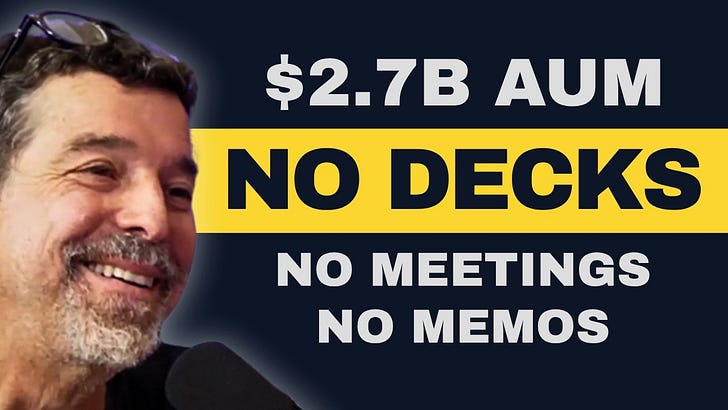
Aydin Senkut started Felicis 20 years ago with $4 million of his own money. He wanted to raise a fund, but every LP told him "we don't back people like you."
He had no prior venture experience. He wasn't technical. And he wanted to invest across every sector and country. He didn’t check a single box.
Today, Felicis is investing out of its $900 million Fund 10, and was early in Shopify, Canva, Adyen, Notion, and Supabase. People called paying 700x revenue for Supabase “idiotic”. Then the company grew 1,000x.
He took me inside 20 years of building Felicis into $4 billion of AUM: why success is the most dangerous moment for an investor, how to keep your edge raising bigger funds, why a generalist approach is best for catching new technology waves, the 7 cold emails it took to meet Tobi at Shopify, the endowment LP who grilled him like the CIA before backing Fund 2, and the 10x rule he learned from Larry Page.
Support this Episode’s Sponsors
Monaco: The revenue engine for startups.
Flex: Sign-up for Flex Elite with code TURNER, get $1,000 here.
Clerk: Everything you need for authentication.
Numeral: The end-to-end platform for sales tax and compliance.
Inquire about sponsoring future episodes here.
Timestamps to jump in:
0:00 Why success is the downfall of a good investor
2:04 Catching waves from YouTube to AI, chips, and defense
4:47 Is AI a bubble? How to tell what's real
6:17 Silicon Graphics: the company with no second act
7:33 Why AI infrastructure spend isn't hype
12:00 7 emails, no reply: how he met Tobi at Shopify
15:30 On adding value: "Just ask the founder"
17:30 The founder pledge: vote with the founders
18:26 Fund 1 was $4M of his own money
21:01 Find LP's preconditioned to believe in you
22:07 Venture is a people business
23:05 Raising Fund 2: the endowment’s "CIA interview"
26:48 Why outsiders bet on outsiders
28:23 Turner's rejected podcast audition
30:46 LP pushback on Fund 2 and Fund 3
32:56 Why he hired a CFO at Fund 3
35:04 Feedback founders can't argue with
37:21 Founders forget the clock is ticking
40:43 Backing founders through the first bad quarter
42:34 Does a 250x bigger fund lose its edge?
45:53 a16z, OpenRouter, Cursor, and big fund returns
47:30 Why deep tech needs huge rounds
50:57 Trillion dollar markets, billion dollar contracts
53:36 Why SpaceX and Anduril alumni will crush it
56:34 From a $50k first exit to "off by three orders of magnitude"
58:17 The software mindset in hard tech
59:38 Google's duct-taped servers
1:00:56 Scanning every book in the world
1:02:37 Larry Page's 10x rule
1:04:54 Outsider founders: Shopify and Adyen
1:07:17 Why Silicon Valley VC's miss companies outside the Bay Area
1:08:16 Generalist vs. specialist: 55 unicorns, no subject experts
1:12:17 Category winners sit between sectors
1:14:59 Don't obsess over entry price
1:17:24 Paid 700x revenue for Supabase, it grew 1000x
1:18:33 Notion, Canva, and the one-button product
1:20:27 The "OpenAI is about to collapse" crowd
1:21:41 Inspiration from Benjamin Franklin
1:23:47 Funding the twinkle in a founder's eye
Find Aydin on X / Twitter and LinkedIn
Check out Felicis
👉 Stream on YouTube, Spotify, and Apple
Transcript
Find transcripts of all prior episodes here.
Turner Novak:
Aydin, welcome to the show.
Aydin Senkut:
Thanks, Turner. Thanks for having me here.
Turner Novak:
So you had something interesting that you said recently. It was something along the lines of, once you see success for the first time in venture, it's kind of like the downfall of a good investor. I forget exactly how you put this quote. You probably know the quote or know the thinking. So what happens there?
Aydin Senkut:
I studied venture a lot before I got started, and now I have 20 years behind me. What happens is venture is one of those markets where when success happens, it's an outlier success. It makes you think that whatever caused that success is going to be the thing that drives it forward.
Like, you know what? I had my dog in the office that way, and I was wearing a blue sweater. Whatever it is, or this market, whatever it was that led to that, it gives you the sense that it's almost like, wow, this is invincible. This is addictive. You get the rush of that hit.
But I feel the thing that makes venture interesting is the high variability in outliers. That means that in the venture market, the thing that made you successful and the thing that was hot and interesting is probably not gonna remain so. The only way you can go back and reset your priors is literally the day after you've succeeded to say, "You know what? Let's go all the way back to the basics, reset." All the expectations that caused where we are today might not be the ones that will take us and move us forward to tomorrow and beyond.
My favorite analogy on that is a surfing analogy, right? You have an amazing wave. You hit the beach. You go back out there not knowing if you're gonna catch another big wave, but that's what the very best venture capitalists do.
The concept of reinvention and repotting is that just because you had the thrill of that amazing wave, now roll back. Paddle back, get back on there, and find the next big wave.
Turner Novak:
So what does that kind of look like in practicality, like actually doing it in practice?
Aydin Senkut:
I mean, look, I think in very simple terms, the way that our firm runs, we're a generalist firm, and we have one obsession. We wanna catch all the major waves that are happening globally. The simplest way to succeed in venture is it's all about high growth, and high growth is all a function of outlier founders and outlier markets. And the way you find outlier markets is it always comes on the back of a wave, not even a normal wave, but a tsunami wave.
Now is a very interesting time because I started my career at Silicon Graphics and Google. I've seen client server. I've seen internet. I've seen mobile. I've seen all the other waves, consumer and all of that. But now with this AI wave, I would say the waves are starting to get more and more monstrous.
The growth is staggering. You have companies that can start with billion-dollar contracts. We are having trillion-dollar IPOs. The sheer scale of things and the sheer intensity and velocity of things have so drastically increased. So that's basically what makes venture interesting, but it was not what people expected.
I don't think anybody expected five years ago that this AI wave was gonna be so huge, or that it was even gonna hit, and it's been around for 20, 30 years.
Turner Novak:
Yeah, we kind of already had these AI hype cycles and...
Aydin Senkut:
Machine learning, you know, blew up and... But then it hit this thing and took off. Same thing, it's gonna happen in robotics. It happened in many other areas where, "Oh, AI can't even draw a picture," and next thing you know, it's photorealistic movies two, three years later.
I mean, it kind of happened in the chip industry. You look at the early chips, they're basically a little bit better than calculators, and now they're doing insane things. So there is this insane growth that is very difficult for human minds to get around, because it is exponential. It is not regular math.
So again, it's just one of those things. You somehow wanna find it, wanna catch it, and wanna ride that wave. And then what we do as a generalist firm is to basically find multiple of those waves.
And we're never religious, right? Twenty years ago, when I first started, I'm like, "Oh my God, YouTube just got acquired. The big thing is going to be video monetization." Then it was consumer. We found e-commerce. It was mostly platforms. Payment platform, credit platform. Next thing I know, we're looking into security and infra, and then AI, and today it's chips, defense.
But it is not by chance. All of these things are going through some major structural shifts where there was so much critical demand. Right now, billions if not tens of billions of dollars of product or services are wanted and needed, and that's a great way to build a company and scale it.
Turner Novak:
How do you identify when something's changing, and maybe when it's permanent and real? Because to this point, there are almost false starts with some of these things.
Aydin Senkut:
Yes.
Turner Novak:
I mean, I don't believe this, but there are a lot of people that say AI is a massive bubble and it's all fake revenue or something like that. Go back to NFTs. There are definitely times where our imaginations get captured by a new technology. So when you're coming across it, how do you decide this is worth allocating some capital and time and resources to?
Aydin Senkut:
When I started in business, what people thought would be my greatest Achilles heel turned out to be an interesting strength for me.
Turner Novak:
What's that?
Aydin Senkut:
That is, I'm not an engineer. I'm not a specialist. I'm not a doctor. I wasn't a VP. I didn't run thousands of people. So everybody thought, "Oh, you weren't a very senior leader. You're not technical. There's no way you're gonna understand the nuances of all these things."
But what they did not understand is that this is more about understanding people. Of course you need to understand markets as well. But I worked at Google, I worked at technology companies. I've been with an extreme outlier, and I've seen how different that was from a standard company where things have kind of gone wrong.
So I have seen the most extreme place where things have gone right. And I've also seen the most extreme place at Silicon Graphics, where things went horribly wrong, and all the time, layoffs after layoffs.
Turner Novak:
What was Silicon Graphics? I've heard of the company before, but I'm just...
Aydin Senkut:
So for you and other people who don't know about the company, it was one of the highest flying technology companies in '96. They were behind the special effects at Jurassic Park. Steven Spielberg was visiting it, Bill Clinton was visiting it. They had these incredible computers and servers that were used in all kinds of different areas. I mean, it was almost like a Google-like company of its era.
It was started by these incredible engineers. The guy who started it was, you know, with Marc Andreessen, started the internet browser Netscape. That was the founder of Silicon Graphics.
If you use any DVR today, that technology was developed at Silicon Graphics. A lot of critical things we use today were developed at the firm. But what they basically underestimated is they had these expensive servers and machines. It's kind of like we make Ferraris, and then one day the Subarus and Hondas are like, "Oh, we're just as fast." And then that was the end of the company, and they didn't have a second act.
Turner Novak:
Okay. So it was a super expensive product, and they were not able to compete when a lower cost...
Aydin Senkut:
The Windows machines came up too fast. Because it's kind of like open source, right? You have millions of people working to make that efficient and better, and Silicon Graphics is a proprietary system. It just couldn't keep up.
Turner Novak:
You could say there are some analogies to today, potentially.
Aydin Senkut:
Potentially. There are some. AI now will probably go a little bit more to open source models. People will be more cost-conscious. And look, history does repeat itself and rhyme.
But going back to what we originally started talking about, the generalist approach is really important because of the way that we make investments. We need to understand what's gonna make a market important at a very fundamental level. Like, hey, if we cure cancer, it's gonna save billions of lives.
With AI infrastructure, whether you think the revenue is real or not, everybody's trying it. You can see people actually use the product, so the infrastructure is really important. There is a trillion dollar spend. That is not bullshit.
You can see it in public reports from Google, Microsoft, Meta, all these public companies. You can see NVIDIA's earnings reports. People are buying chips. Oh my God, now the next big bottleneck is memory chips. The next big bottleneck is data centers and energy. We don't have enough energy.
China has 10 to 100 times the energy we have. It's actually also a national security risk.
So the way that I like to combine things is, first of all, is this something that every person in the world or every business in the world is interested in or can use? And then, is there urgency to it? So for instance, payments. When we invested in Adyen, if you're a business, the thing that makes you a business is processing payments.
Turner Novak:
It's the revenue, like what's happening with money.
Aydin Senkut:
You know, like e-commerce, like Shopify. As long as humans have existed, there has been trade. I don't think you need to be an expert to understand that if you are an amazing trading platform or commerce platform, if you do really well, you're gonna succeed.
So none of these things were rocket science. I didn't need to be like, "I worked at eBay and I was a commerce expert." All I was looking for, from what I learned at Google, is what makes each founding team in each company unique and an outlier. Where I'm like, "No other company or founder has ever paid attention to this, or has ever excelled in this one area."
Or they have this one or two secrets that nobody else seems to be realizing, even though there might be other players. That's basically what we do. And then we build a book of these kinds of companies and all the big waves that we think are gonna be important, and so far it has served us very well.
Turner Novak:
So I think maybe Shopify's an interesting one, because I know there's this famous story of Tobi biking up Sand Hill Road and pitching everyone. And it's a snowboard selling website or something that he just kind of made. And it's like, "Ah, get out of here. Nobody's gonna buy stuff online." So what was it like when you met Tobi and the team?
Aydin Senkut:
No, it's a real story, because I showed up... Crazy story. So I'm married to a Canadian, and I'm trying to impress my wife. In addition to, also, it's an incredible company.
Turner Novak:
Were you guys married yet, or dating, or...
Aydin Senkut:
We were married.
Turner Novak:
Oh, you were already married. Okay.
Aydin Senkut:
So we were already married. I mean, she's not gonna get out of the marriage just because I can't win the company, but...
The funny thing is I keep sending email after email to Tobi, and there's just no response. So seven emails, no response. Then I find this Canadian woman, Debbie, who was partially also in media PR. I'm like, "Debbie, look, he hasn't responded to any other email. Will you also send another email?"
And she sends the email and Tobi responds. He probably was thinking, "Look, if I don't say yes, this guy is gonna keep sending me emails and intros from 20 different people." But he basically threw me a curveball and said, it's whatever, January, February in Ottawa, it's negative 30 degrees.
So I remember getting ready for the trip, and I'm like, "God, I don't have a coat thick enough to handle the weather." So I go buy this special coat, get on a plane, and show up. And every single thing Tobi told me was like the early days of Google, where everything you'd expect a search engine would do, that was not what Google was doing.
All the search engines add more buttons, and Google is like, "We have zero buttons." Search engines hire experienced people, and Google is like, "Nope, we hire the smartest people, and they figure it out." Every single dogma, they basically took it and turned it on its head.
I show up, and the first statement from Tobi's mouth was, "You are here because the Silicon Valley VC that we wanted," and I'm not gonna name the firm, "basically told us that we cannot build this firm in Ottawa. We have to relocate to Menlo Park. I am not going to relocate to Menlo Park." And so that was our opening.
So, you know, "If you convince me, and you're a good person, and you believe in our company, you might have room in the syndicate." It took six months and a lot of work, but we were in.
Turner Novak:
Took you six months? That's a long sell.
Aydin Senkut:
I mean, six months including all the emails.
Turner Novak:
Oh, got it.
Aydin Senkut:
I mean, it wasn't six months from when I showed up. But one of the things that was really cool is we also have this saying of engineering serendipity. So I was also thinking, "God, I'm not an e-commerce expert. How can I help?" But this is the kind of founder hustle. Sometimes you're in the situation where you're like, "Wow, I've never experienced this before. I need to figure out a solution."
So at the time, Shopify was just as good of a platform, they just didn't really have a big marquee customer to keep increasing the awareness. And we had also just invested in Angry Birds maker Rovio.
And Rovio badly needed an e-commerce site right before the holidays. So I connected the two of them, and Rovio was so happy because they were like, "This is going to be a huge merchandise business." I don't know if you remember, but people were loving those...
Turner Novak:
Yeah. There was a movie and stuff too. Angry Birds.
Aydin Senkut:
Yeah, there was a movie. So even before the movie, the merchandise was huge. And Shopify loved it because they got this marquee customer. It wasn't like, oh, this is a huge chunk of the revenue share, but it was very public, and it really boosted their awareness.
And so they loved the fact that we were thinking like we're an early employee of the company. How can I move the needle for this founder and company? You help them hire somebody important, you help get a really impressive customer. By the way, when the connection was made, both companies were like, "This is amazing," but neither company knew about each other.
There are so many situations in the world where a good match exists, but that doesn't mean that the people are aware that it should be made. And so that's why we like this concept of engineering serendipity a lot.
Turner Novak:
So then how do you figure out how to be valuable in that sense, in a way that is helpful for the founder? Because I feel like a lot of founders will say that with VCs, if you just do nothing, you're in the top 10%.
And so there's a lot of this trying to help too much. So how do you know that you're actually being helpful and doing something that the founders actually want you to do, versus just getting too involved?
Aydin Senkut:
Let me give you this crazy, complicated answer.
Turner Novak:
Okay.
Aydin Senkut:
I just ask the founder. "What do you need? What is the most important thing to you?"
Turner Novak:
Okay.
Aydin Senkut:
So first of all, it is something that does not scale. Everybody is so smart that they're thinking, "Oh, I can't afford to ask every founder. I'm gonna do this one thing, and I'm gonna offer that one thing to every founding team in every company."
It's great because then it's very easy to talk about. We have this one thing. That's what we do. But the reality is we have hundreds of founders. We ask every single one of them, and the answer was never the same.
You're a founder. Every founder is going through different trials and tribulations. There is something they need. It's very scary to us because a priori, you don't know what they're gonna tell you. They might tell you, "I need X," and you're like, "We're out of luck. I don't really know what to do about that."
But guess what founders do? They're faced with curveballs all day long. They're in situations where they're like, "I don't know. I'm not experienced enough to handle it." But your job as a founder is to figure it out.
And so the benefit of being a founder and investor is I know what's going through their mind, because I had to do it for my own firm. I'm a startup in venture capital. Maybe now, on Fund 10, maybe a more mature startup, but with that attitude of no hustle is too little, we're here for you.
And to your point that even if you do nothing, you're in the top 10%, there is actually something that is not called out, and it's been a rallying cry for us. Most founders do not trust their investors.
So the other thing that we did was we have the founder pledge. We basically say, "We will never vote our shares against you." Even just doing that puts us in a small number of firms that are really special and unique, and I don't think anybody followed us.
So to this day, every founder that comes through the door says, "You know what I heard about Felicis? You guys vote your shares with the founders, and you give founders the founder pledge." That's 1% of our investment, from our management fees, that they can use for therapy or coaching or anything.
So with the horrible example of Travis with Uber, our job is to make founders unbreakable. In your most fragile state, people come after you, and we're like, "We wanna do the exact opposite. We wanna invest in your mental strength. We wanna make you more resilient so that you're unbreakable when you're facing stress." And actually, when they're most successful, they're facing the most stress.
Turner Novak:
So talking about determination and being unbreakable, Felicis Fund 1, it was all your money, which is a little bit unusual for a VC fund.
Aydin Senkut:
I mean, yes. There are other people that have done it, but yes.
Turner Novak:
Somewhat unusual. So it was a $4 million fund. So why was it only your own money?
Aydin Senkut:
Because nobody wanted to give me money. So I'm like, "I have a little bit of extra money. I can go take a chance." And look, I don't blame them, whether it was friends or whoever. I totally understand. Because if somebody said, "Hey, Turner, I'm raising a fund," you'd be like, "Well, why are you raising a fund? Why would I back you?"
You wanna look for some validation. Have you run a company? No. Are you an engineer? Are you technical? No. I mean, I was the first PM at Google and the first international sales manager, and people are like, "Have you done venture capital?" No.
And then my strategy was very unique. We always had this strategy, even from day one. We had zero logos. Like, you have no podcast and you're getting into podcasting. And my dream was, I'm getting into venture capital. I am not gonna copy other firms. I'm gonna do something drastically different.
That was to look for underestimated founders globally and invest across sectors. And I wanted to break every orthodoxy rule in venture capital that LPs have. As a result, almost every LP that I talked to said, "Get out of here. We don't back people like you." And I'm like, "I'll start with my own money."
And after four years, I had 12 exits and 100 investments. Two things really happened. One is, if you make 100 investments, it's like you wanna be a professional athlete. If you basically put in more hours and work than anybody else by a factor of 10, I think no matter what your natural talent is, you're gonna be pretty decent.
And the second thing is I got 12 exits. I mean, there were so many new funds getting started, and then LPs are asking, "Well, why are we backing you?" And people are like, "I have three markups," or whatever. It's paper markups, and that's not bad. It's great, but having a real exit...
And I wanted to raise $40 million, and I already had a $100 million company exit, and then multiple exits to various different firms. So in some ways, you can say the LPs looked at me. For the first LPs that backed me, it was like, this guy is ex-Google. There are hardly any ex-Google people. He already has 12 exits. He made a lot of investments. He seems to be a really good fit for his strategy.
It just happened to be other LPs that were like me, that were starting out, and they were backing this new breed of investors called super angels.
Turner Novak:
So do you think that's probably a crucial thing to consider when you're a fund manager, or maybe a founder too? Finding the investors who are already preconditioned to buy into the thesis that you're pitching, whether it's very legible to them down the fairway or whether it's a little unorthodox? You need to find people who are already preconditioned to believe.
Aydin Senkut:
Indeed. And preconditioned meaning that... Years after, I went back to my LP, and I'm like, "I'm really curious. Why did you even take a chance on us?" Then she said, "Number one, there were a lot of factual things to support the decision to back you."
But also, my very first LP said something really interesting: "Look, we're also just starting out. The very best funds are not giving us allocation. So we think the alpha is gonna be in this new class of managers that maybe the very upper echelon doesn't care about."
"But we think they're going to have a lot of alpha because they're underestimated. It's kind of like this overlooked part of the market, but we think this is going to be where the puck is going." And they did extremely well.
Turner Novak:
Yeah. In a way, it's almost like your strategy was, "I'm gonna go to these unproven founders in weird markets that other people don't really wanna give a chance to." Because there's something better next door that's more attractive, and what's more, the markup's gonna come quicker.
Aydin Senkut:
What I'll tell you, the most amazing thing is, everybody thinks this business is all about making money and crazy returns and all of that. Yes, it is, but people really underestimate how much of a people business it is.
And I think what has happened, at a fundamental level, is the founder saw somebody just like them. Somebody that has been underestimated and is trying to break through, trying to break the orthodoxy, prove the skeptics wrong.
So we always connected at a human level. There was a reason why, even though we were the smallest fund and we were not the most established, we somehow always managed to break into these incredible companies and founders. They looked at us and were like, "You just need to be in the syndicate."
Turner Novak:
And so, raising Fund 2, I know that one was also hard, too.
Aydin Senkut:
It was a bit hard.
Turner Novak:
Yes. But it was easier in the sense that somebody actually did say yes. You did have people that invested.
Aydin Senkut:
The first yes was the most meaningful. Then basically what happened is several people said yes, but we still had a big gap.
And then our law firm made an introduction to one of the largest LPs in the country, an endowment. I sit across from this man who runs the endowment. He was 6'6", very imposing, and I'm like, "I don't have a prayer in hell. There's just no way he's gonna say yes."
Turner Novak:
Yeah.
Aydin Senkut:
He basically grills me for a whole hour, asks me the toughest questions. At this point, it's like a CIA interview.
Turner Novak:
Do you remember what kind of questions he was asking you?
Aydin Senkut:
It was all kinds of detailed questions. Like if you applied to the CIA: "Turner, you know what? We don't care... We gotta freaking go all in on all your..." I mean, we gotta go very deep.
So he just went very deep. At the very end of the conversation, he said, "I'm gonna tell you a crazy story." I think our story really inspired him. He said, "My grandmother, from a small village in Virginia, was the first from the state to relocate to Turkey and become a teacher in the American school in Turkey in 1927."
So there was something in his mind that somehow connected to his grandmother's background, and he's like, "I'm gonna give this guy a chance." He still grilled me, by the way. He grilled the crap out of me. But there was something in his mind like, "There is something I see in this person."
I don't know if that really helped or not. But look, human beings are always looking for something, and he just gave us a chance.
And one thing that I'm really proud of is we rewarded that faith in us. The funds that they invested in performed really well. All our funds are performing well, but the early ones performed exceptionally well, with incredible liquidity. I was very happy. "Thank you for your faith, but we've done our job to show that you were right to back us."
Turner Novak:
Yeah. Are you Turkish?
Aydin Senkut:
I am Turkish-born.
Turner Novak:
Turkish-born, okay.
Aydin Senkut:
American now, but Turkish-born.
Turner Novak:
Okay. So there's a little bit of the preconditions to want to identify with and support someone who is related to you, or similar to you in a way.
Aydin Senkut:
I mean, look, I think every human being does that in some sense. And it doesn't just have to be where you're born or your religion or your sports team or college.
Look, human beings are tribal. That's how we survived through the ages. You want it to be more than arm's length. You want it to be more than a transaction. Do I get you as a human being? Do I understand what makes you tick?
And I think at some level, you realize that all my life I was always in a minority situation. I was always underestimated. And what makes people great, what makes outliers great, is everybody's like, "It's this one thing." Every outlier founder has it, but it's mostly the motivation.
They're unstoppable. They have amazing grit and resilience, and in some ways I can relate to it. Because when people tell you you suck and you're never gonna amount to anything, what are you gonna do? Either you take it and you're depressed for the rest of your life, or you're gonna show them, "No, actually, I can amount to something."
But that thing is like rocket fuel. You are so motivated to prove to people that you're not a loser and you don't suck. A lot of founders go through that, you know? And I think that's why I relate to them, and that's why they relate to us. They definitely see it in our absolute fabric.
It's definitely part of how we bond with them and how we relate to them.
Turner Novak:
Yeah. It's actually kind of funny. Before I started the podcast, there was this one really popular business podcast that had almost an open call. Like, "Hey, we're expanding the show. We want a couple of new hosts to come on and try some new formats."
And I was like, "Oh, that'd be kind of fun. I'm probably pretty good at hosting a podcast. I'll try out and do it." And basically, I didn't make the cut. I was like, "Oh, I guess maybe I wouldn't be that good at a podcast." And that kinda always hung on me.
Then I was like, "You know what? I actually think I'd be pretty good at this. I'm actually gonna do it." That's not the only reason, of course. But in the back of my mind, it's like, man, I kinda just wanna prove that I can, in a way.
Obviously, having a podcast is not the end goal in life. It's a means to an end, I guess.
Aydin Senkut:
Well, I think it's really cool. You get to meet a lot of very interesting people. You get to ask a lot of questions.
Turner Novak:
Yeah.
Aydin Senkut:
Because with all these stories, there is the obvious part of the story, and there is the non-obvious part of the story. So I think you're doing an incredible job.
Turner Novak:
Yeah, it's pretty interesting because I'm a really small, early-stage fund.
Aydin Senkut:
Mm-hmm.
Turner Novak:
There's probably not very many of them that get to go hang out with the CRO of a company that's about to go public...
Aydin Senkut:
Yes.
Turner Novak:
And just hang out for two hours. How'd you do it? You open source it, put it on the internet.
Or the co-founder of another company that's doing over $1 billion in revenue just hung out for two hours yesterday. I found out, I didn't even realize, he's also in charge of a lot of the acquisitions that they're doing.
And I'm like, "Oh, this is pretty good." Jeez, like you say, "I've got a portfolio here, just in case," you know? So you kind of build up. You're not necessarily thinking strategically, or maybe you are, like, "Okay, I can use this to build my network," right?
Aydin Senkut:
Yeah.
Turner Novak:
Same with us. We probably wouldn't have hung out for two hours if we weren't recording this.
Aydin Senkut:
But look, at the end of the day, I think another part you're touching is networks, human networks. This is a networking business.
Turner Novak:
Yeah.
Aydin Senkut:
And you need to find out where the great talent is. We were very lucky. I think one of the ways to find the talent before it's obvious is, again, you gotta figure out the ways and you gotta go after them. But kudos to you for following your path.
Turner Novak:
One thing that I feel like comes up a lot: you were a solo GP, especially with Fund 2 still, right?
Aydin Senkut:
At Fund 2, Sundeep ended up joining me. He was the first person that I hired, so I had...
Turner Novak:
Okay.
Aydin Senkut:
Another investor. But it was still a very small team. It was Sundeep and I, and then we had an office manager who wore many hats.
Turner Novak:
Okay. Did you get any big pushback as you were raising Fund 2, Fund 3? Was there a lot of non-belief from folks? What was the biggest, "Hey, this is the reason that we're not investing"?
Aydin Senkut:
Look, I think the early pushback was a lot less about solo GP or not solo GP. First of all, we were trying to do something unique where it was very awkward to have a generalist fund. It wasn't very common that they would back generalist funds.
And then we're like, "Hey, we can invest anywhere in the world." That was another big anathema, because the traditional Silicon Valley wisdom is you've gotta keep these founders on a leash. Invest close to you, because you can keep a close eye on what they're doing.
Turner Novak:
Yeah.
Aydin Senkut:
I'm like, "These people are pretty great. Why would you wanna keep a close eye?" It's not like they're in kindergarten. They do not need adult supervision. A lot of VCs thought that the founders need adult supervision.
Turner Novak:
Yeah.
Aydin Senkut:
Because look, we're talking about outlier people here, right? You do not wanna kibosh the thing that gives them this outlier potential and the energy.
So I think a lot of the pushback was people thought, generalist fund, no prior venture experience. In Fund 2, at least we could say 100 investments, 12 exits. But then they're like, "Okay, well, these exits are not significant enough. How is it gonna continue?"
And then every time, we're like, "Nope." It's the exact same strategy. The exits multiply drastically, the scale of the exits multiplies drastically. We literally said exactly what we were gonna do. Now we're in Fund 10, and it keeps getting bigger, keeps getting a lot more exits.
Now I think there is almost no disbelief on that. It's more other questions. Another thing people were wondering is, hey, how is this strategy gonna scale, and is it gonna be important enough? But we put more score on the board. We put score pretty early on the board, and we made some really interesting decisions.
On Fund 3, we hired a CFO. Most of my peers were like, "Why would I spend money on a CFO? I'll just get somebody who's outsourced." And I will never forget this. We had the Fitbit exit. There was a small window, we sold the stock, and the stock crashed. And then I had peers who didn't have a CFO who did not sell, and they rode the stock to the bottom.
So there were a lot of reasons that they were initially like, "We don't know if this is gonna work." But then we did one thing extremely well: we really leveraged our board. I literally came in front of them and said, "Our aspiration is not just to be a venture fund. I wanna be among the very best. I want you to absolutely battle test us with everything you know about what it will take to perform at that level."
The first year or two, the board meetings were brutal. They were like, "This is wrong. You're off. You don't know this."
Turner Novak:
What were some of the biggest things where they were like, "You don't get it"?
Aydin Senkut:
I'd ask stupid questions like, "Why do you need reserves?" I made these statements, and then they put me in my place, and I'm like, "Yes." Later on, I understood why. They wanna partially defray their fees with recycling. It wasn't the reserves, it was the recycling.
But anyway, look, they had really good questions. They thought most VC managers are pretty stodgy and pretty stoic, and nothing is gonna change. A year and a half later, we had a board meeting, and when the meeting started, I'm like, "What do you think?"
And there was no question. It was incredible. They thought it was gonna take us 10, 15 years to do 10% of what they asked.
Turner Novak:
Mm.
Aydin Senkut:
And in a year and a half, we just ran through the whole list and then everything else they had. Now I'm like, "Bring it on. What else you got?" It was really great, because it's kind of like having a very tough coach. It sucks when you're in the gym and when you're practicing.
Turner Novak:
Mm-hmm.
Aydin Senkut:
But that's what excellence requires. You want people to question everything that you're doing and hold you to the highest standards.
And later on, when we have really tough times with the founders that we work with, it's something that I do. One of the things you asked earlier is, what do you really do for your founders? Sometimes what you need to do is tell them the truth, and the truth is very difficult to hear.
But the one thing that we do is we always put data behind it. I never say, "Turner, as a founder, look, this is a bad situation." I say, "You know what? Let me break it to you. We have hundreds of companies. Here's the ranking of everything you do across the portfolio."
Because we're generalists and we have a broad book, we never tell somebody you're good or bad. We just tell them, "Here's the market, and here's where you are. What do you think?" You can process the data, and it's very hard to argue with that.
Turner Novak:
So what might I be seeing if I'm a founder and I'm looking at this from you? What am I looking at exactly when you're showing the cross-portfolio, cross-market data?
Aydin Senkut:
Yeah, very critical things. For instance, "I'm doing really great. My growth is awesome." Well, your growth is 40th percentile.
"I'm doing very well. We're hiring a lot of people." Your burn is in the bottom quartile. Both are factually true. One is kind of the impression of someone, and then I'm putting hard data behind it.
And this is kind of my obsession with F1. One of the reasons why F1 is really cool is everything is micro measured. Every single detail is measured. So when you have data for every tiniest thing in the tiniest possible increments, it's almost impossible not to manage it really well.
There's a lot of complexity. But my dream is to come in front of founders and not just say, "You're good, you're bad." Just put data. Data is something that's hard to argue with.
Turner Novak:
Yeah. So then something like that might be, "We're hiring so many people, things are going great." We're in the bottom quartile on burn, but also my pipeline looks really good, and the rate of velocity of deals closing is in the top decile.
So then you could say, "Okay, maybe it's okay that the burn rate is a little higher, 'cause it looks like it's ramping even faster than the others."
Aydin Senkut:
Absolutely. Look, every founder is getting some great things right. But I think there is a more subtle point here. Every company is going through these things where something is kind of wavering. Some things are not great.
Turner Novak:
Mm.
Aydin Senkut:
There is one thing that nobody talks about. It is not whether something is good or whether something is bad. People forget that there is a clock ticking. So the most important thing is for you to be aware of it before the clock ticks and you're in the 11th hour.
If I just said something is good or bad, people get stuck on, "You're telling me something is good or something is bad."
Turner Novak:
Yeah.
Aydin Senkut:
But what you really should be asking is, "How much time do I have?" So we also keep a very strong eye on what the cash runway of the company is. How much time do we have to make decisions?
So it's not just that you have to make hard decisions. It's how much time you have to make that decision. The earlier you know about something, the more time you have to make a decision, especially if it's a hard decision that's going to change the trajectory of the company.
Turner Novak:
Any times that's played out in a good way?
Aydin Senkut:
It always plays out in a good way. I don't think there has been a single instance where there's good feedback or constructive feedback and it didn't. Now, the founder might not appreciate it as much in the moment. But I don't think there has been a single founder who didn't say at the end, "You know what? That was tough love," or, "That was not easy to hear."
But then stuff actually materializes. Because it's data, and because we can see the market, they can see it too. Later on, something happens, and they're like, "Yep, that's exactly what happened," or, "You were right, the data was correct."
So that to me is sometimes really, really important. And not sometimes. It's one of the most important things. Because I was underestimated, one of the things that drives me is I want the founders to see that we really care. More than writing a check to them, we really wanna help them change the trajectory of the company.
Whether it's doing the things that they ask us, hopefully we do a good job consistently. We really try. We work very hard. We're building a team to help us do that even more. But it's also saying the right things at the right time.
Turner Novak:
Mm-hmm.
Aydin Senkut:
So that it's not too late before you have to make a decision. Because there are many instances where you're on a board, you're a lone voice, and other people are saying, "Everything is good."
And then nine months pass by and it's like, oops, everything is not good. And not just that, we have three months left. What are you gonna do about it? So there are times when you know something and you have time to react. And there are other times when you know about it, but you know about it too late.
People did not tell you, and you did not realize it. Now you do not have time to actually handle it. So that, to me, is why it's super important. And the only way you can do that is if you have trust.
If you didn't trust me and I told you something hard, you would say, "Get out of here. I don't even know you." But if we somehow earn your trust, we did something that moves the needle for you, we proved that we can really help you, you're like, "Aydin, I might not enjoy what you're about to tell me, but I'm willing to listen to you."
Turner Novak:
Yeah, at least give me that.
Aydin Senkut:
"I don't promise that I will act on it..."
Turner Novak:
Yeah.
Aydin Senkut:
"But I'm willing to listen to you."
Turner Novak:
Well, I feel like that seems to be a common trait of the best founders. They know how to take different feedback from different people, and know when to act on which feedback.
Aydin Senkut:
Yeah.
Turner Novak:
Which sounds super easy when we just say it like that. But in certain circumstances, like with the example of burn rate and pipeline ramping, some people might say, "You need to cut the burn rate right now." Some people might say, "You've gotta go with your intuition. If these deals are closing, it's okay."
Aydin Senkut:
Yeah. I do need to add something, though. There is another part of this which I think is even more rare. Sometimes founders wanna do crazy things, and the investors are like, "That's just batshit crazy."
And sometimes what they really want is one of the investors to say, "You know what? That is batshit crazy, but you should absolutely do it. I trust you, and you will do great. And I will prove it, I will put even more money in the company."
There have been a number of situations, like n8n or Semgrep, where the company's doing really well and inevitably there is a little hiccup. As soon as the first hiccup happens, people start getting agitated. "Oh my God, we missed this quarterly goal and this one stat."
And we do something very unusual. We're like, "You know what? Yes, you had a bad quarter. Maybe you had two bad quarters. But the main trajectory of the company is going to a really great place. The reason why the numbers were off is because we have a very small n."
Every startup, when they're starting, there are not enough deals, there are not enough people.
Turner Novak:
Yeah.
Aydin Senkut:
One thing is slightly off, and it's going to derail the results.
Turner Novak:
Yeah, you have a deal that closes in July instead of June.
Aydin Senkut:
Yeah. If you look at it, you're like, wow. But that's the point where the founder is really vulnerable. And we do something different. We're like, "We'll give you more money. We'll give you support. We do believe in you."
And the founder is like, "Wow, this investor is not just telling me things. They're also willing to back it up. They wanna put even more money in our company at a moment where things seemingly were not that great."
Turner Novak:
Yeah.
Aydin Senkut:
And that part, I think, is very unique to Felicis. Look, if we exist 20 more years from now, that means we made a lot of good decisions. But I would like to say one of the key reasons is we've also done right by the founders. I don't think without that we have even a 1% chance of persisting through the next two to three decades.
Turner Novak:
So one thing that comes up a lot: you started with a $4 million fund. I think the latest fund is $900 million?
Aydin Senkut:
Just about, yes. A little over.
Turner Novak:
Okay. So a lot of people will argue... I mean, the scale of that is 25x more. Am I doing the math right? No.
Aydin Senkut:
About, roughly. I mean, if it was a billion, it would be 25... Yeah. Hundred, what? 250.
Turner Novak:
250 times more. So do you have the same edge that you had with a smaller fund? Do you lose anything as you scale up the size of it? 'Cause that's a common general thing in venture. They're like, "Oh, you're just getting fat and old," and you lose your edge.
Aydin Senkut:
It is... Math is math. And on the topic of fat and old...
Turner Novak:
Yeah, I'm not saying you're fat.
Aydin Senkut:
I'm not gonna say I'm a young person. But I was meeting with another investor today who was an ATP Top 200 player. We were talking about exercise.
Turner Novak:
Is that tennis?
Aydin Senkut:
In tennis. And I'm a tennis fan.
Turner Novak:
Oh, nice.
Aydin Senkut:
I work out six days out of seven a week. I measure my sleep. I train like an F1 or NFL athlete. I am very serious about it, 'cause this business is very stressful.
What people don't realize is if you're not in the best shape, you're not gonna be able to make good mental decisions. When you're dealing with a lot of stress, one of the things that gives you resilience is the shape that you're in. So I'm absolutely freaking committed in every possible way to be a high performer.
Turner Novak:
Yeah.
Aydin Senkut:
But look, math is math. But I think what is overlooked, first of all, is the people that make it really special. The other thing that I will say is, first of all, we own like 5 to 10 times more of the companies.
The exits have grown in scale 10 to 100x. And we are also writing bigger checks to companies, and it's because of our fund size that we've been able to get into some companies. So when you run the math that way, there's been about, I would say, 2 to 3x inflation just in terms of venture valuations.
If you say, "Hey, a $4 million fund from 20 years ago," that would be at least $12 to $16 million today. It's not the official inflation figure. If you look, you take your 250,
Turner Novak:
You cut it down to like...
Aydin Senkut:
100x. A billion is already like 250 from that. A billion today is more like 250 was 20 years ago.
Turner Novak:
Yeah.
Aydin Senkut:
The exits have been 10 to 20x larger, so now we're down at like 10 to 20, and then we own like 5x of each company. So actually when you do the math that way, it sounds like, oh no, with this large fund, you're absolutely gonna get crushed, and it's exactly the opposite. Actually, the fund size is what allowed us to continue with our ambition and scale and even get into some companies and rounds, and that's always been the dream.
Every time our fund size increased, we tried to expand the strategy. We used to only do seed and a little bit of A, maybe, if we're lucky. Then it was seed and A, and we still do majority seed and A. But there are other situations, good examples like Supabase and Runway, where we did what looked like a growth round, but it really was a seed or early A.
They had hardly any traction. It was a crazy valuation, which is another hot topic, I know, and people thought we were batshit crazy for being in those rounds. And then those companies went literally from like $100,000 to hundreds of millions of revenue in a matter of years.
Turner Novak:
And I think even as we speak, there's... So a16z is the epitome of high fund sizes, large fund sizes, and I think within the past day or two they've had multiple companies in the portfolio that have been acquired or exited for high 11-figure amounts. 10, nine, 10. I guess, yeah, nine and 10 figure amounts. So 12 and 13 figure.
OpenRouter, almost $10 billion it seems like. Seven, something like that. You've got Cursor getting acquired by SpaceX. And I'm pretty sure they own a good chunk of both of those businesses.
Aydin Senkut:
But you check.
Turner Novak:
Yes. So then you have this class that's been saying, "Oh, you can't get returns with that big of a fund size." And it's like, well, it looks like you can actually.
Aydin Senkut:
Not only that, but look, the world has changed. 20 years ago when I started, it was the software wave, so actually you didn't need a lot of money and you could start a company, and every week some company was getting bought out. So we had so many $100 million, couple hundred million exits, scaling to billion dollars.
Now you have a different situation where you have exits that are much, much larger.
Turner Novak:
Yeah.
Aydin Senkut:
But it's also deep tech, hard tech. Like we talk about AI, infra, defense, a lot of these sectors, and this is not a capital light business. These sectors are not capital light. You do need a lot of capital, which means that you need a minimum check to enter.
And so without this fund size, honestly, there are a bunch of companies, I would say maybe a quarter to nearly half of our book, where I don't know if we would've been able to get into those companies.
Turner Novak:
So how does that happen? Why are the round sizes bigger and the capital required more? What's going on that's different? Are they opening a factory? Are they manufacturing things?
Aydin Senkut:
It could be a factory, it could be manufacturing. I mean, you are seeing NVIDIA's earnings reports. You have to train models, you have to get GPUs, you have to hire people, which is very expensive. Even outside of Silicon Valley today, it's very expensive.
You need to buy a lot of data. Everything in deep tech is very expensive, and you need to put a lot of money up front to get there. But then you get rewarded because it's very difficult, and very few companies are in there. I mean, we have companies like Periodic Labs, and they're doing something insanely difficult.
They basically said, "Look, a lot of AI is focused on experiments and data, but there is one area where we do not have data and it has never been captured, which is physical experiments." In science, a lot of it was simulation, especially in key things like, hey, we wanna have a new material for transistors, or we wanna have a new superconducting material.
These are very important physics problems, and there are other chemistry problems. It's a very difficult thing to say, "Hey, you know what? We have a new synthetic material," because you need to test it in the real world, in the lab. And so this company literally spent, God, tens of millions, and they might spend hundreds of millions, to basically build a new kind of rapid scaling.
They wanna be able to go from dozens of experiments to thousands of experiments a day. And they are like, "Listen, nobody in the world is doing this."
Turner Novak:
Mm.
Aydin Senkut:
Everything was simulation. So on the one hand you're like, "This is batshit crazy," because they're gonna spend all this money to build an environment where, at the moment, you have a very good understanding that it could be important, but there is no immediate commercial thing. The commercial thing only comes if you have a discovery.
So you have to suspend disbelief and say, "I'm gonna do thousands of experiments. I will know the synthetic material will work, so I will be the first to market with the next superconducting material or the next synthetic metal that can be part of the new generation of transistors." But the promise of those is so big that the company will keep raising the money. I think they will have the breakthroughs, and then it'll be very important money.
But they have to put a lot of money up front to be able to do that, and that becomes the moat of the company. Then they are like, "We are the only company in the world that has that infrastructure that can do those experiments."
Turner Novak:
Yeah, 'cause it's kind of this classic thing where it takes a ton of investment to get to that scale. And it's not like software where the margins are like 99% on a new dollar of revenue. There are some physical things, so the math and the physics of trying to get up there and compete is pretty difficult.
Aydin Senkut:
Pretty difficult. Yeah. And it's a fantastic story. There was a machine there that's made in Austria, and I think there are like 20 of them in the world.
Turner Novak:
What is the machine?
Aydin Senkut:
It's a very weird machine. It basically consists of X-ray spectrometry. When you have a new invention, it's very difficult to see on an atomic level what the composition is. This machine combines two very difficult technologies and can see at a molecular level whether you have certain things present in what you think has come out from the experiment that you ran.
Turner Novak:
Interesting. One thing that you said earlier that I think is worth touching on is that the size of the outcomes that we're seeing is a lot bigger. A lot of people are saying this also. In the past, say in 2021, it was a very common argument everyone had.
Like, oh, the outcomes are way bigger, so let's also go bigger. Are we just doing the same thing again with the valuations of these companies getting bigger? We're saying $100 billion is the new $10 billion or $1 billion.
Aydin Senkut:
I think one thing that's a little bit different is some people make arguments without the data to back it up.
Turner Novak:
Mm.
Aydin Senkut:
We have a different attitude. We look at the data. We might be generalists, but we know how to do our homework.
Turner Novak:
Know how to read.
Aydin Senkut:
So this is why I call it trillion dollar markets with billion dollar contracts. The companies we have now have either a billion dollar contract or a multi-billion dollar contract, and you can see if that works, it's going to scale to $10 billion.
And I'm like, take that contract. If they ship it, we know it's going to be like $3 billion in revenues, and you put a multiple of five to 10 on it, it's not difficult at all. We're coming into this company at like a $1 billion or $3 billion valuation. I'm like, "I will take that bet any day." Right?
It's not gonna be like we're going from $5 million to, if we're lucky, 20, and 20 will become 50, and 50 will become... We're way past that. Now even Anthropic had a billion dollar contract with, I think, AWS first, and then Databricks had a billion dollar contract with Microsoft.
Now, the company is much broader and bigger than that. They're not necessarily our companies, but we're seeing other companies, whether it's in defense or chips or other areas. I mean, we are in an era where Google is spending $100 billion plus a year on data centers, and there are five other companies like Google. If you had asked me 10 years ago if Google was gonna be spending $100 billion a year on CapEx on anything...
Turner Novak:
Really.
Aydin Senkut:
I'd be like, you are not just batshit crazy, you should be on Mars. There's just no way that that's gonna happen. So I think when we say something, it is actually rooted in data. It's not like, oh, we're just guessing that numbers seem to be going up, so we will be a little bit bigger.
No, it's real data. It's real growth. I've been doing this for 20 years, and if you add the other 10 years that I was an operator, I've never seen growth figures like this. I've never seen initial contract sizes like this. I've never seen companies that can recruit like 50 people in just three months.
Turner Novak:
Yeah.
Aydin Senkut:
And you know why it's happening also? Because we have so many more startups. This is one of my favorite data points that nobody captured. When I first left Google and Facebook was about to go public, there was this Google/Facebook, I can't call it Meta, dynamic.
Turner Novak:
Yeah.
Aydin Senkut:
And I said, "The reason why Facebook succeeded is 'cause they hired 1,500 people from Google." They were pre-trained and ready, waiting to be deployed at a new company.
Turner Novak:
Mm.
Aydin Senkut:
If Google did not first hire and train those people, I don't know if Facebook would have ever become this big.
Turner Novak:
Really?
Aydin Senkut:
And you know what's happening in the press now? Because of Anduril and because of SpaceX, there are hundreds of super qualified, super ambitious engineers that once thought they had crazy dreams, and now they have seen that crazy dreams can become real. So nothing is gonna stop them.
Guess what's gonna happen next? Between SpaceX, Anduril, and Palantir, you're gonna have some insane hard tech companies, and they're absolutely gonna crush it. I can absolutely see that they're gonna crush it.
Turner Novak:
So why are they gonna crush it? What's kinda changed?
Aydin Senkut:
Because you have very brilliant people that are approaching classical areas with a completely different lens, and in the past it's never been done. So let's say you're one of those engineers, and it's never been done. Maybe you would second-guess yourself and say, "You know what? I'm probably crazy. It's not gonna work."
But now that we have had rockets made at like a hundredth of the cost of NASA, and the rockets are self-landing, do you think anybody's now ever gonna doubt that something batshit crazy can be done?
Turner Novak:
Mm.
Aydin Senkut:
That's human ingenuity at its core, right? There have been so many times that humans are like, "It can never be done." And lo and behold, an outsider comes and says, "I think it can be done this way." And next thing you know, it is done.
And so I feel like for the most part, technology was focused on software only. But now it is touching everything else. So this is the new era where you can truly suspend disbelief. There actually are people now, like when we're talking to somebody about, "Oh, this new nuclear technology," and I'm like, "Who is this person?" Oh, it was one of the core people at SpaceX.
We backed one of the SpaceX founders, Scott. He wrote every piece of software for the Falcon rockets. You think the guy that figured out how to build these rockets from scratch, did the simulation, did the testing, launched them, made them land, is not gonna be able to figure out the next thing? Of course he will.
You might say I'm batshit crazy to think it's inevitable, but I've seen the fire and I've seen how different he is. And it reminds me very much of Larry and Sergey, where for 10 years traditional people told us we're batshit crazy, and this stupid little search engine is never gonna monetize, and we're never gonna create a real business that can make real cash.
And $5 trillion of valuation later, I wish I had some of those comments recorded. It would be really funny to put it together.
Turner Novak:
Yeah.
Aydin Senkut:
We are by a factor of 1,000x beyond what people said we could do.
Turner Novak:
Isn't there a famous line where people were asking him, "Could you ever get to $100 million in revenue?" And he's like, "I wanna get to billions in revenue." And now they're closing in on $200 billion of revenue a year.
Aydin Senkut:
Yeah. I mean, this is the funny thing. When I was at Google, in the early days, I'm like, "God, please make this a billion-dollar company." I was off by three orders of magnitude.
Turner Novak:
Yeah.
Aydin Senkut:
And same thing as a VC. I had my first exit, and it was literally a $50,000 convertible that returned $25,000. I'm like, "Can I make a million dollars one day?" And then it's 10 million, then it's 100 million, then it's a billion, like an IPO. Next thing you know, we might have a $100 billion IPO, and there is a $2 trillion IPO now with SpaceX.
I think one of the things that I'm seeing, especially in things like robotics, is I don't think people realize how vast the market is. A lot of these markets, I think, are misunderstood because we never had somebody build a product that truly captured the market.
Turner Novak:
Hm.
Aydin Senkut:
We have 190 million people in labor. And by the way, just because you have robots doesn't mean that people are unemployed and are not gonna do other stuff, right? I mean, we have teller machines. It doesn't mean that we don't still have people at banks that talk to customers.
So I just think that this is a really strong argument. A lot of jobs will be taken by technology and robots, but then there will be other really interesting, even more intellectually rewarding jobs, and even more creative and satisfying jobs for people.
I don't think it's a zero-sum game. I don't think it's one of those things where for technology to scale from here and do these immense things, humanity has to lose. I don't think that is true.
Turner Novak:
In terms of some of these outside of software categories where we're seeing startups made, I've heard that in the past when we tried this, 20 years ago, 30 years ago, it was someone in a certain industry, whether it's energy or healthcare. It's someone who is from that industry and doesn't move at startup speed, per se.
And so you hit a wall and can't get around it. Versus today, it's the guy who did it at SpaceX, and he's done it before. And he's got the same kind of mentality. So that's why it's kind of worked today, because we've adapted the software mentality to the real world now.
Aydin Senkut:
I think it's the software mentality, but it's also outlier mentality. Elon Musk is an outlier for a reason. Jeff Bezos is an outlier for a reason. Larry Page, one of the things is they freaking don't do anything by convention. Every single thing that was done at Google had nothing to do with the way those things were ever done before.
Every single thing, they were like, "Nope, we don't like it. It's not good enough. It's not fast enough." This 10x rule, most of it is like, "Nope, we're gonna do it completely differently." It was crazy, but it really worked.
Turner Novak:
So anything interesting, like the most memorable unconventional way of doing something?
Aydin Senkut:
I mean, there was more basic stuff, like Larry basically designed these crazy servers at 10:00 PM at night. We thought, "Oh, we have all this money. Why don't we just go buy servers?" He's like, "Why would I buy servers? It's a huge waste of money. They're inefficient, they're very expensive, they're not designed to do what I want.
I'm gonna go buy these cheap Intel CPUs, and we're gonna buy a crap ton of disk. We're gonna literally duct tape it. And this guy, Sanjay, who just started a new company with Jeff Dean, he's gonna write..." He basically wrote the precursor of AWS, like the S3. Literally 10, 15 years before Amazon did that, he did an inside version at Google.
And he's like, "Sanjay is gonna run software." We basically used such cheap chips and disks that they failed all the time, and it pissed people off. They were like, "It's okay, we'll just write software." There was literally somebody whose job was to write babysitter software that knew when things were failing, and then somebody's like, "Run to the data center, 10 more disks need to be replaced."
Literally, people would go with drives and they would plug the drives in. That's early Google days.
Turner Novak:
Yeah.
Aydin Senkut:
Nobody rational would ever do that, but then Google fucking scaled way faster and way more economically than people imagined.
Turner Novak:
Have you figured out when is a good time to do something like that? Was there a reason that they built the servers differently?
Aydin Senkut:
Well, that was the more obvious thing. Let me give you the more batshit crazy example. There was a moment one day where Larry and Sergey are like, "Look, I think one of the biggest threats to us is all the knowledge captured in books. What if somebody captures it? Because we are only working with knowledge that's already on the internet, on the internet pages. There's a lot of knowledge that's not on the internet."
And there were skunkworks projects for a whole year where they took a bunch of people, like 10 to 20, and said, "Okay, you're gonna come up with a scanner that is insane. It has to scan like 10,000 books a day," or something like that. I forget. It's some crazy stat.
Turner Novak:
Okay.
Aydin Senkut:
And they literally spent a whole year on it. I don't know any other company where, first of all, rational people would go into a room, let alone say, "Everything that you're asking me is virtually impossible. No fucking way it's gonna work," and then they made it work.
Turner Novak:
Mm.
Aydin Senkut:
And then it kept happening over and over and over again. One day, they come to Google, and they're like, "We bought a satellite data company." Why do we need a satellite data company? It became Google Maps. One day we came to work, and 96% of the world uses Search, 98% use email. And one year later, like six months later, Gmail was born.
So it was beautiful. There were these moments of such extreme clarity where everybody realized... And by the way, not everybody agreed, but everybody realized it's important. Even though we didn't figure out monetization, or that it could be useful, until 10 years later, they were not afraid to take these huge bold bets.
Turner Novak:
Hm. And you mentioned something about 10x. I don't know if that's specifically what you're talking about. Do you have this 10x filter or framework that you kinda use? So what is that?
Aydin Senkut:
It's very simple. It was Larry's mental framework. I had many times where he asked me something really difficult, and I'm like, "Shit, I really don't know how I'm gonna do it. It's very tough."
But he basically told me, "Look, I have this 10x mentality that everything that you do has to be at least..." By the way, at least. 10x is not the maximum, it is the minimum. "10x faster, 10x cheaper, 10x better, ideally all three." Three orders of magnitude.
Turner Novak:
Mm.
Aydin Senkut:
And he said, "First of all, if you do that, whatever you put out is going to matter." Right? If I say, "That Apple Watch, I can give you for one-tenth the cost," you're like, "Fuck yeah. Let's get the watch." Of course I would wanna pay one-tenth the price. Or, can I get you a watch that has 10 times the battery life? You're like, "God, please. I've been waiting for this."
Turner Novak:
Oh, I actually have a notification, 1% battery life right now.
Aydin Senkut:
There you go. There you go.
Turner Novak:
Good timing.
Aydin Senkut:
So first of all, it is definitely gonna fucking succeed. But the second thing is, the only way you can do that is you need to be batshit crazy and think of a very creative way, because if that was easy to do, it would've already been done.
So the only way to push beyond convention and force people into outlier thinking is to ask them something that is so difficult that they have to completely unwind and un-build their mental framework, and then recreate it again to make that happen.
Turner Novak:
And it's almost like you can't have the framework in some... Like, you have to start from...
Aydin Senkut:
No, you have to start from absolute scratch. There's no way to make it work otherwise. Now, it was scary as hell. And then he said, "Look, the reason why I'm doing it is because if I told you, 'Hey, Aydin, 20% would be great,' you're gonna use all standard methods."
Turner Novak:
Mm.
Aydin Senkut:
If you basically said, "I know how to make it 10% or 20% better," it's 'cause you're doing something that is not game-changing enough, where the standard method is gonna scale. But if I'm asking you for 10x, the standard method is not gonna scale.
Turner Novak:
Yeah, 'cause you might just make this 20% smaller, and it just costs 20% less, and there you go. Solved it.
Aydin Senkut:
Or whatever, you give a little bit more battery space, and because you have battery, it can last, like, 20... But then you have this monstrosity on your wrist, right?
Turner Novak:
Yeah, it overheats more or something like that.
Aydin Senkut:
Yeah, 'cause you made the battery bigger.
Turner Novak:
Yeah. And it feels like maybe that ties back to when Felicis kind of had a lot of success investing outside of the bubble, founders outside Silicon Valley. Is that part of the success of a company like Adyen, Canva, Shopify? Is it that they're not in the conventional tech bubble way of thinking about things, or?
Aydin Senkut:
I think the answer is yes or no. I mean, look, I've still seen Google-like elements in those companies.
I remember my first meeting with Shopify. Tobi was telling me how excited he was, when he had only like 40 or 50 engineers, to take two or three of the best ones and create a real-time data warehouse. And he's like, "They're gonna work on something that's gonna make no money, it's gonna take a lot of time, and it's my best talent."
Turner Novak:
Okay.
Aydin Senkut:
But then the infrastructure is so important that it's going to set up the company for major success. The only other people that I knew that were crazy enough to do something like that were Larry and Sergey. They did things that were very unscalable, but also very important. This, you know, 10x mentality.
And then I went to Adyen. The reason why I found Adyen is because I found out even Google and Meta were having major issues in countries like Brazil. They couldn't process payments. The financial system was too complicated.
I'm like, "Well, did any company figure out how to do it?" They're like, "Yes, there is one company. It's Adyen."
And most people didn't know about it because they powered Braintree in the US, so people just didn't realize this company even existed. In fact, my favorite story is that Adyen was a special company, but when they were first getting announced in the US, I called the Wall Street Journal. The Wall Street Journal was like, "We don't have the company in our database. We don't even know it exists."
Turner Novak:
What?
Aydin Senkut:
It is... I am not making this up. It's a real story. I was so proud. I freaking found an investment where the Wall Street Journal doesn't even realize the company exists.
Turner Novak:
Wow.
Aydin Senkut:
Talk about being a contrarian, right?
But all of these companies... I mean, the Adyen team had like 100 years of payments experience. What they realized was that a lot of payment stuff, if you take the Google approach, was all old rails, and nobody freaking wanted to change the old rails.
They're like, "Fuck this, we're gonna do the new rails, and we're gonna do something that we always wanted to do but couldn't do in the old fintech companies. We're gonna build a new breed of fintech platform." And it was amazing.
Turner Novak:
So was there a common reason that a lot of Silicon Valley investors, or the top ones, quote unquote, "miss" some of these opportunities outside of the Bay Area?
Aydin Senkut:
I think it's much easier to say we're gonna invest in the Silicon Valley version. You don't have to work as hard. There is less risk. Nobody's gonna blame you if it goes wrong. Like, well, you backed some amazing Silicon Valley founders. Who's gonna tell you that you were stupid to do that?
Turner Novak:
Yeah.
Aydin Senkut:
It's definitely more risk. It's definitely more work. It's definitely more suspending of disbelief and having more faith. But to me, it's more rewarding. The journey is the reward, you know?
I used to tell my kids when they were very young, "Dad is just like Indiana Jones, except that I search for these amazing companies that are diamonds in the rough." That's my true...
Turner Novak:
Indiana Jones.
Aydin Senkut:
Yeah. I mean, he looks for treasures. I look for treasures that happen to be companies, where most people don't realize how special they are.
Turner Novak:
Yeah, and you've talked a lot about being a generalist investor. A lot of people will say, "Oh, you should specialize. Generalists, you don't know what you're doing. You don't have the expertise. You overlook things. You get too excited."
So what do you think a lot of people miss on this generalist versus specialist debate? Why does being more of a generalist generally outperform being a specialist?
Aydin Senkut:
I mean, we have the data to prove it. I've made probably about 250 investments myself alone. We have well over 400 investments. We have 55 unicorns, which probably doesn't matter today. Nobody cares about a billion mark anymore, but we...
Turner Novak:
Yeah, you can start a company and get a unicorn.
Aydin Senkut:
We have roughly 20 IPOs and more. So we had some decent successes. We had about 160 M&A exits, and not a single one of those companies was led by an expert. Not one. Hundreds, dozens of companies, and not a single one was led by a subject expert.
So there's this argument from specialists saying, "If you're not a specialist, you're not gonna understand it." I think what ends up happening is if you're a specialist, you are so deep in the subject matter that you're gonna look at a batshit crazy way of doing things, and you're gonna say, "That can't be done."
Now, there are also benefits, where you're really smart and you can find companies. So there are multiple different arguments.
One, sometimes when you're an expert and there is a crazy, outlier way of doing things, you're gonna say, "No, it can't be done." It's easier to say it won't work than to say it will work, because you are so deep. You've been trained for 20 years. Now somebody's saying all those 20 years, the experience you had and the things that you learned, are wrong. It can be done this way. It's very against human nature to say yes to that.
Versus if you're a generalist, you know what? I'm not a chip expert. I can say, "Wow, this is a new approach. I can see why it's gonna work. Let's fucking go."
And look, we are not stupid. We do diligence. We obviously understand the market. We know the things that make a company special. I do think that generalists have a much larger playing field.
I kind of think about a tennis example. We're on a tennis court, and the specialist is like, "I'm gonna hit the shot, and I'm gonna thread the needle, and I'm gonna put it right in that little area close to the line." And the margin for error with that is really small.
With the generalist approach, I'm like, "You know what? I can hit the ball on this court. I can hit the ball on the next court. I have the whole court, and in fact I have seven different tennis courts." I have a lot greater margin of error. I also need to choose where to play and where to place my shot, but I have so much to work with, it gives me a lot of margin for error. I think I'm gonna be much more likely to make the shot.
And I also have this contrarian attitude. One of the things that I learned about being a generalist investor is that there is a lot more in common between the companies that we have in different verticals.
The argument is like, oh, Shopify has nothing to do with Adyen, which has nothing to do with Rovio. One is a gaming company, one is a commerce company, one is a fintech company. Now we have a defense company, we have a chip company. But I like to argue that all of these founders had very interesting common threads.
They were all outliers in completely different businesses, and they did some very simple, crazy things that might not overlap one-to-one. But I think understanding the outlier nature of these companies and founders trained us really well to pick other ones in different geos and different industries.
And by the way, we did not invest in Canva because it was in Australia. We thought, "Wow, this company is going to change creativity forever." It just happened to be in Australia because there was an ex-Google and ex-Meta team from failed products, and those engineers really wanted to prove themselves right.
There was an incredible founding team with Melanie and Cliff, and also Cameron, and they were like, "Hey, let's take these engineers and build something great." And the engineers wanted to prove they were not losers.
Turner Novak:
There's kind of this overlap of different specialties, like sector specialties, in something like that. Like an Australia-focused investor or a design-focused investor or a cloud investor or something like that. And all those different mega trends are kind of all coming together.
Whereas if you look at it in isolation, maybe you might say, "Oh, design isn't big enough," or, "We've seen in Australia this won't work," or something like that. But I feel like there are a lot of cases where the best companies kind of overlap a bunch of different themes. They kind of create a new market, or create the need for a new expertise in a way. I don't know if that's fair to say.
Aydin Senkut:
I mean, look, I think part of it comes down to this. In an outlier business, even if you look at sports, for instance, if you look at all the quarterbacks or whatever, pick any sport. I don't know what your favorite sport is. But the very top echelon, those people are different than the others.
Everybody is good to be in that league, but if you look at the people that go to the highest level, the playoffs and even beyond, the ones that are in the Super Bowl, they are absolutely a different breed.
And so what I basically learned is that you're an outlier business, but your business is like, "We're only gonna look at companies in Australia." There have been a lot of VCs that were like, "Oh, we're a Canadian VC." Well, how many of them invested in Shopify? "Oh, we're a Finnish VC." How many of them were in Rovio?
So there were so many instances. There was Blackbird, famously from Australia, and Canva, because they were like, "Wow, we're supposed to invest in Australian companies. Thank you, Canva, for being here."
But most of the time, the local VCs don't have a large position, or they actually don't see it, because they're just basically doing something different. They're like, "Hey, our mission is to invest in Australian companies." No, your mission as a VC, and this is the generalist dream, is the very best companies in the world, regardless of where they are.
Versus if you're a specialist, like, "Oh, I love the world, and I'm an optimist, but I can only invest in fintech companies, or I can only invest in consumer companies." And what if something happens that's no longer true? What are you gonna do? Right?
Turner Novak:
I could see, like, "Oh, we're fintech, but we're B2B. We're not consumer." Or, "We invest in Australia, but Canva, you're trying to go to the US, so I'm sorry. This isn't for us."
I think one interesting thing with Canva is people said you were crazy when you invested, because I think the revenue multiple was like 100x or something like that. I'm not sure exactly what the number was.
So is it super important to focus on the valuation? What's the thinking around when you bend the rules? How do you price a seed round, a Series A, even a Series D? How do you think about the valuation of these companies?
Aydin Senkut:
I study Charlie Munger and Warren Buffett a lot, and they talk about this concept that one of the secrets of making great investments is to have a large margin of error. In the beginning, they were buying the companies cheaply, and the margin of error was that you're buying it so cheaply that you're almost guaranteed to make a return. Later on, it was quality assets, but they're gonna find them when the quality asset is distressed, or right at the perfect moment.
Turner Novak:
Yeah.
Aydin Senkut:
It was their formula. So everybody thinks, "Oh, to be like them, you need to copy." No, you just need to understand that concept and apply it to your specialty.
So the way that I think about it is, look, we have one and only one business, and our business is not called invest in the cheapest company. Our business is not called invest in the lowest valuation. Our business is supposed to generate the best returns. To generate the best returns, you need to have the company that is the fastest-growing.
To be the fastest-growing company, you need to have an outlier founder. Do you think an outlier founder is going to wanna give up his shares very cheaply? They're not stupid. They know that they are the best, so they're going to demand a premium valuation. That doesn't mean that every premium valuation company is going to succeed and become a huge company.
So the way we think about success and margin of error is that I want a company with a growth path so promising... I like to use the word 100x. We talked about 10x. When I look at a company, the very first thing I ask is, "Is there a true 100x revenue growth potential in this company?"
Turner Novak:
Grow 100x revenue from here.
Aydin Senkut:
100x. So if I'm wrong and the company grows like 50x, and I paid like 2x, I'm still gonna get 25x. So I'm not even saying 5x, I'm not even saying 10x. What I'm really looking for is a true 100x potential. Now, I know it's pushing it a little bit, but that's why we choose the markets that we choose. That's why we choose the founders we choose. It's such a special combination, and you also have to get the timing right.
And look, I can tell you, even from our own data, you look at all the companies where we have the highest ownership, where we got the best valuation, and none of them have made it to the top.
And every single one of our outlier companies, oh my God, we barely eked out like a 1% ownership. The valuation was horrible. I was having heart attacks. We paid like a 700 multiple for Supabase, and everybody thought we were absolute effing idiots.
Turner Novak:
Yeah.
Aydin Senkut:
And then you look at it and the company grew like 1,000x. Not even 100x, 1,000x.
Turner Novak:
Yeah.
Aydin Senkut:
I was off by 10x on the 100x growth goal.
Turner Novak:
Yep.
Aydin Senkut:
How can that be not great? They are missing the whole fucking point. The whole fucking point is to find a company that's gonna grow not even 100x, like 1,000x. And then it doesn't matter what price you paid.
Turner Novak:
Yeah.
Aydin Senkut:
You know what I mean? The founder is not gonna tell you, "My company's worth $10 billion," when he has like $100K in revenue. It's going to be expensive, but it's going to be expensive with a math function. So if you pick a company in the right place at the right time that has so much growth function, then valuation becomes absolutely not important.
And if you're so hung up on the valuation, you're always gonna miss those outlier companies. The same thing happened to Google. They basically said, "Two PhD students?" People were like, "It's never gonna work."
Turner Novak:
Mm-hmm.
Aydin Senkut:
Notion, by the way. We're the only VC that invested in Notion and Canva. I remember Ivan. Right? Now that it's at scale, every VC wants to be his friend. We basically wrote him the first check on the back of a napkin, right?
And then with Canva, people said, "Oh, it's Australia, Sydney. What do these people know about scaling a company? It's a design company. Look at Adobe, it's a $200 billion company." And what's going on today?
Turner Novak:
Yeah.
Aydin Senkut:
You know? It's totally different. People always look at all the things that can go wrong, instead of the one thing that can go right that would make this an incredibly large company.
And then Canva became very large, and it wasn't about the 100x multiple. We were like, oh my God, the true creativity company does not exist. There was basically Microsoft PowerPoint, which was a piece of shit, and then there's Adobe, which is great, but it's so complex that you need a university degree to run the product.
Turner Novak:
Yeah, it's kind of a different product than Canva, and a different customer that they're going after, really.
Aydin Senkut:
But the point is that everybody in the world wants to be creative. Do you wanna feel dumb when you use a product? The first thing is you open Adobe, and I don't know what the fuck to do with this product.
Turner Novak:
Yeah.
Aydin Senkut:
I mean, I did. I opened Photoshop. I was like, wow, I need to go back to graduate school to learn Photoshop. I mean, yes, people learn it, but you just wanna create. And that's something that I learned at Google. When you came to Google, there was one button. There was no other stuff.
Turner Novak:
There was just search.
Aydin Senkut:
You just search. Or I'm Feeling Lucky. And you know what? The result is fucking great.
Turner Novak:
Yeah.
Aydin Senkut:
I love it. That's it. That's what people want. Give me the one-button product.
And so that's why I'm like, Canva's vision was really great. If the founders execute it... Do you think it's really difficult to execute? They have this killer crack team of ex-Google and Meta engineers. They have this beautiful idea, and I'm like, "I think they're gonna execute." And then the next thing we know, the company goes up 1,000x in sales in eight years.
Turner Novak:
Yeah. Well, I think, too, when you just look at... You don't look at the data, per se. I feel like there's this one guy who's been saying OpenAI is on the verge of financial collapse for a couple years now. What's his name? Ed Zitron or something like that? And like...
Aydin Senkut:
Oh, Zitron research. Yeah.
Turner Novak:
Yeah. He's this journalist who does these really long exposés of, "I've looked at the numbers, and OpenAI is six months from insolvency." And he's been saying this for a couple years.
But it's almost like you can look in isolation at, wow, Facebook paid a billion dollars to acquire Instagram. That's never been done before. A billion dollars for a photo-sharing app. That's the worst deal ever. But actually...
Aydin Senkut:
It was the best deal, actually.
Turner Novak:
It is, actually. You could actually make a lot of money from the photo-sharing app now.
Aydin Senkut:
Or Google paying a billion dollars for YouTube. They're making like $10 billion in profits a year now, or something like that, off of YouTube.
Turner Novak:
Yeah. I guess it goes back to the founder making a bold bet, like doing the real-time data, or "we'll acquire YouTube," or "we'll build our own servers because it does X, Y, Z."
I have a question. Do you have a favorite founder, or maybe investor, or a historical figure that you've gotten a lot of inspiration from? Could be an athlete, too.
Aydin Senkut:
One of the historical figures that inspired me the most is actually Benjamin Franklin.
Turner Novak:
Mm.
Aydin Senkut:
I went to Penn for grad school, but the thing that I love about Benjamin Franklin is how many different things he invented or innovated. He started a university. He started a hospital. He did all these crazy things. It's one person.
Turner Novak:
Didn't he also negotiate with France for them to come in and help us in the war?
Aydin Senkut:
He also did that. Yeah. I mean, I just wanna be 1% of Benjamin Franklin. I'm so inspired by him.
And one of the reasons for that is that the reason why I do this job, and I love this job, is that I'm an eternally curious person, and I just wanna keep finding... I'm not starting these companies, but I wanna be part of their journeys. I wanna find these founders that remind me a little bit of Benjamin Franklin. They wanna do this insane innovation, and I wanna be part of that journey, and I wanna repeat it over and over again. I just love that rush.
I love the journey. By the way, the journeys are never perfect. There are also really tough moments in the journeys, emotionally taxing ones. I love every minute of it. I don't just love the goodness. I can also take the badness.
So I think Benjamin Franklin is really inspiring, and he basically pushed humanity forward. As a result of the university he started 250 years ago, hundreds of thousands of students got educated and got really smart, and look at what they have done collectively. As a result of his innovations, science has progressed. We negotiated whatever treaty with France. Just think about how important even one of those things would be. He's done dozens of those things.
It's just super inspiring. We have this one life, and sometimes I think we think of it in a very limited way. Like, this is the little box, and this is all I'm gonna do. And all my life I'm like, "No, I do not wanna be in that little narrow box. I'm going to invent my own box. This is the box. And I'm gonna create, and it's gonna be a lot bigger, and it's not gonna have these narrow lanes."
And I love doing that with founders. So whenever I'm with a founder and they're like, "This is the dream," I'm like, "Batshit crazy. Love it. Let's go."
Turner Novak:
I mean, that's the point of starting a startup.
Aydin Senkut:
Yes.
Turner Novak:
Kind of the point of venture capital is funding people doing kinda crazy shit. And maybe it will work. And what happens if it works is kind of the point of it.
Aydin Senkut:
Maybe, but I think the founders also have kind of a good idea. You know?
Turner Novak:
Which, fair, yeah.
Aydin Senkut:
Yeah. There's a little twinkle in their eye, like, "Yes, there's a lot of risk, but there's this little thing or two." And then the next thing you know, some really amazing things happen.
Turner Novak:
Next thing you know, you've got Google and Canva and Adyen, Shopify. The list goes on.
Aydin Senkut:
Yeah.
Turner Novak:
Well, cool. This has been a lot of fun. Thanks for coming on the show. Appreciate it. Thanks for having me at your office.
Aydin Senkut:
Thanks, Turner. Appreciate it. Thanks for being here.
Find transcripts of all other episodes here.