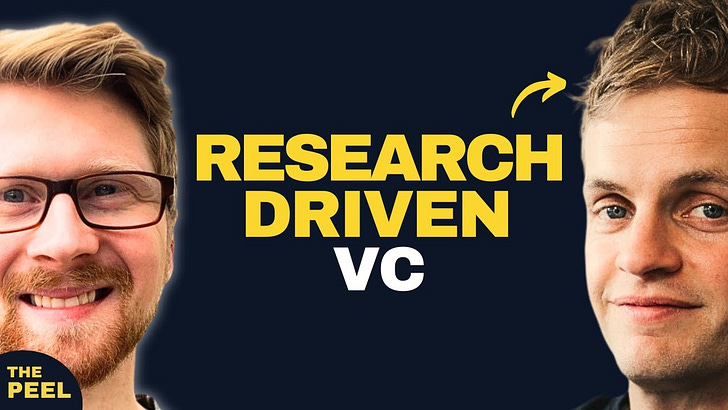
Bilal Zuberi has spent 18 years investing in hard tech. He made defense tech bets 15 years before anyone cared, and led Lux’s investment in Applied Intuition’s Series A in 2018 (now a $15B company).
In 2025 he left Lux Capital ($7B AUM) to start Red Glass Ventures and go all in on AI that touches the physical world.
We hung out for a few hours and he shared everything he’s learned over the past 18 years:
Why hardware is still hard despite the current sentiment, and what has actually changed
Why the deployment layer is the most attractive part of physical AI
What he looks for in the founders he backs
The 90% pay cut he took to leave Lux and start Red Glass
How small funds quietly became outsourced associates for the big guys
Why the “AUM as a moat” chants is a warning sign
The math behind becoming a billionaire off management fees without ever returning a dollar to your investors
Why consensus investing is a circle jerk
This one’s for anyone building and investing where AI meets the physical world, or who just wants more inside baseball on starting and running a venture firm.
Support this Episode’s Sponsors
Monaco: The revenue engine for startups.
Flex: Sign-up for Flex Elite with code TURNER, get $1,000 here.
Clerk: Everything you need for authentication.
Numeral: The end-to-end platform for sales tax and compliance.
Inquire about sponsoring future episodes here.
Timestamps to jump in:
0:00 Leaving $7B to bet on physical AI
0:51 What most people get wrong in physical AI
4:17 Why a startup has to become a business
11:31 Hardware is still hard, so what changed?
15:40 How government went from SBIR mills to real customer
17:48 Robotics goes from hard-coded to probabilistic
23:34 Where value accrues: full stack, then wedges
25:24 How Applied Intuition became a $15B company
28:03 The deployment layer is the real prize
32:22 OpenAI and Anthropic hint what will happen in physical AI
36:14 Why customers have all the downside
37:56 The best founders paint a picture and execute
40:53 Why it's called Red Glass (founders chew glass)
42:17 Every founder hates fundraising, even Travis
44:29 Red Glass's four core values
50:49 Why founders really take your call (the $250k effect)
53:28 What Bilal looks for in a founder
58:44 Why technical founders underrate fundraising
1:00:26 The Tiger Global era
1:04:02 From $10B to $100B, the goalposts moved
1:06:21 Is this a bubble? Portfolio construction
1:08:55 Building a firm that outlasts him
1:12:13 From Nobel-lab chemist to Zero-to-One investor
1:13:45 Are small funds just outsourced associates?
1:16:35 When AUM becomes the moat
1:18:34 How big funds choke off SPV money
1:21:24 The risk of VCs backing competitors
1:23:31 Why fund economics push everyone bigger
1:26:20 Consensus investing is a circle jerk
1:29:51 You can be a billionaire on fees alone
1:33:09 Equal carry and the right to win
1:35:55 Why good ethics in VC matter
Find Bilal on X / Twitter and LinkedIn.
Check out Red Glass.
👉 Stream on YouTube, Spotify, and Apple
Transcript
Find transcripts of all prior episodes here.
Turner Novak:
Bilal, welcome to the show.
Bilal Zuberi:
Thank you. Thank you, Turner. So good to see you, man.
Turner Novak:
It’s awesome to see you too. I’m really excited, because we haven’t really gotten a chance to sit down and have a two-hour conversation, I don’t think, ever before. So this will be fun.
I think probably the most interesting place to start is that you have been investing in what we now call physical AI for 18 years. You were at a pretty large fund, Lux Capital. I think they have, I think Claude told me, five billion in AUM.
Bilal Zuberi:
Seven billion.
Turner Novak:
Oh, it’s seven? Oh, $7 billion in AUM. You left to start your own fund. You know, it wasn’t necessarily the hottest thing in the world, but suddenly it is. People will not stop talking about it.
So as somebody who’s been doing this for a really, really long time, what do most people typically get wrong when they first start to invest in something that’s not just software?
Bilal Zuberi:
So number one, many thanks to Jensen Huang, who I think in January 2025 put up this chart that now people have seen many times, where he says there’s AI, then agentic AI, and then physical AI. And I was like, “Oh my God, the future is physical AI.”
You know, 18 months ago, when I was starting my conversations with LPs that maybe I should do a fund, there were many LPs who said, “We’ve never done investment in this area. This is capital intensive.” And then I tried to tell them, “No, it’s not, at least not the way I’m approaching it or the kinds of investments I want to do.”
But it was an uphill battle, because, you know, oh, this is probably only large funds can do this, where you can write big checks and hold onto your positions. That has completely changed in 18 months, and everybody wants to invest in it. The way Jensen describes physical AI, it feels like a little bit more narrow, around robotics and autonomy and so on.
The thesis of my fund is AI and the physical world. I think there’s tremendous innovation happening in AI. I think we all realize that at this point in 100 different ways. And I think we want to fund some of those fundamental innovations, but we also believe that AI is going to have a massive impact in real-world physical industries.
You know, things that we consume, this table, this glass, the food, the energy we consume, the industrially produced products that we have, and so on, defense and all that stuff.
What are the mistakes that people make? I mean, look, number one, there’s a lot of very smart people investing in this space, and they’re coming from different vantage points. Some people have been doing it for a long time, so clearly they bring that expertise. They also bring scar tissue to it. So sometimes their problem would be that they’ve seen too much, and they know 100 ways to fail, and that’s all they think about, so they sometimes miss the big idea, because they’ve seen something like it before, and they wouldn’t do it.
But for newer people, go to market in these industries is tough. Decision-making in your customers is much more complex. The incentive systems of your customers are not exactly aligned with you.
Turner Novak:
Really?
Bilal Zuberi:
They want better products, but they just want to protect their market share more than anything else.
Turner Novak:
Hmm.
Bilal Zuberi:
They’ve never seen rapid growth, and oligopolies or monopolies, that doesn’t really happen to them. They would love to push all the risk to you, and you as a young entity might assume all that risk thinking that’s what it takes, not realizing that there’s not enough at stake for your customer to be there for the long term.
So you end up sometimes investing in companies that feel like a big idea, but the practicality is missing.
Turner Novak:
Hmm.
Bilal Zuberi:
One of the things I talked to LPs about as I was doing fundraising was that, of course we want to fund big, important ideas, change-the-world ideas, and companies that can become very, very big, and hopefully the entire investor ecosystem will want to be a part of that at various stages.
So it’s not some niche fund. But I also said that we want to back founders who understand what it takes to turn a startup into a business.
Turner Novak:
So why is that such a big deal?
Bilal Zuberi:
Look, you and I can create a startup during this podcast, probably costs less than $25 to register, and we can call it “We’re Gonna Go Mine on the Dark Side of the Moon,” and likely get admitted into some accelerator and even get funded.
Turner Novak:
Yeah, I mean,
Bilal Zuberi:
Especially with you and my background. These guys know how to raise money.
Turner Novak:
Yeah, I can spin up Claude right now. While we’re talking, Claude can go and we’ll have a website and a product.
Bilal Zuberi:
These days people are saying, “Can these guys raise money?” And if you can raise money, great. People want to fund you, so we can do that.
But a business has customers who buy products. When they buy a product, they give you revenues, and the revenues are real only when there’s margin associated with that. And going through all those steps is non-trivial. It’s finding a customer on the other side that cares about your product enough to part with real dollars toward you, and in a way that’s not just real dollars while they know that you’re packaging a dollar with every product you sell to them, but you are actually generating margins and profits on the other side.
That’s a tough ask. And I think the greatest companies that I’ve been fortunate to be part of have figured that out. As their business starts to grow, they also start to grow their TAM. So they’re turning their startup into a business, and the business is becoming bigger and bigger on its own, expanding, and the opportunity set in which they’re building is becoming bigger.
Those are the businesses that I think are just the most amazing ones.
Turner Novak:
So it’s basically, you need to make sure on day one, or as close to day one, you can sell a thing profitably, you’re going to make money. Maybe the TAM in a spreadsheet or in a market report can or cannot be big, but it actually has to be large long term, whether or not the spreadsheet says it does. It has to materialize over time.
Bilal Zuberi:
It’s not so much that you have to start selling day one. You have to do real development, real product work, but you have to understand what it takes to sell. I met somebody earlier today, remarkably smart individuals building a research lab in a very important area. But when you reach the point of, what is your path to turning it into a product that people actually use, they just haven’t thought about it.
And they don’t see that as a priority, which is fine, because they’re researchers who are basically doing research that just happens to be inside a company, and in today’s climate they’ll get funded. But I think that cannot be your portfolio. There could be a shot on goal that you take in your portfolio. There’s room for something like that, but that cannot be the majority of your portfolio.
Turner Novak:
You mean as an investment firm portfolio? Okay. So it’s almost like you need to be commercial, like the founders need to be commercial and know how to get customers to pay them for the thing.
Bilal Zuberi:
Isn’t that the purpose of starting a company?
Turner Novak:
I mean, I think so, but
Bilal Zuberi:
Why do we start a company then? I don’t understand if we’re not trying to be commercial. I feel like, are we professors? Are we research? Are we basically saying nobody will give us money in a university, so let me create an alternate form of a university and do research there?
Don’t take me wrong. Vinod Khosla and others who funded OpenAI, it was not commercial. It was a non-profit.
Turner Novak:
Yeah.
Bilal Zuberi:
Vinod could do that, but Vinod can also give a billion dollars to somebody as a non-profit grant because he wants that to exist. That’s very different than necessarily an average VC who’s trying to do remarkable investments and make a mark on the world, to the extent that Travis Kalanick was saying everyone wants to make a mark on the world.
Turner Novak:
Mm.
Bilal Zuberi:
We’re trying to find amazing individuals who will create real value, who will create real products, who will improve people’s lives, and who will create products that have economic value in society. And that’s what we get paid for in return, because then society says, “Thank you for building that. We’ll give you a lot of money because I think you will continue to add money for a long time to come, and hence we will apply a multiple to it that will be pretty high, and you can cash out, and we will continue with the company going forward. Thank you very much.” And that’s what we call an exit.
Turner Novak:
Does that happen a lot, you think?
Bilal Zuberi:
I think so. I think so. I think a lot of VCs are motivated by commercial offerings. VCs are responding to the environment that they’re in. They know what their job is, but sometimes they feel like in the interim you’ve got to do what everybody else is doing, and if everybody else is funding research labs, then maybe I should have a research lab in my portfolio as well. And then some get carried away.
But I think VCs, investors generally, understand that their job is to invest in something that creates long-term real value.
Turner Novak:
Mm-hmm.
Bilal Zuberi:
And people may differ on how long it takes to create that value.
Turner Novak:
Hmm.
Bilal Zuberi:
That’s okay. You know, SpaceX is a very old company. Tesla is very old. It feels like a new company, but it is not.
I don’t think anybody has a 23-year fund. I don’t think my LPs are willing to give me 23 years. Now, maybe if it becomes, at the end of 12 years, if it’s starting to look like SpaceX, they’ll hold onto it. But otherwise these are 12-year funds. In fact, a 10-year fund plus two has become very common. Maybe they’ll become 15-year funds. But that’s roughly the timeline that you’ve got to make your mark on the world with that company.
Turner Novak:
So what’s happened over the past couple years? Because if I go back three, four, five years ago, I feel like the mantra was, “Hardware is hard.” So what’s changed that people are now all of a sudden really excited about the category?
Bilal Zuberi:
Hardware is still hard. I really encourage people to not let VCs tell you that hardware’s become easy.
Turner Novak:
Mm.
Bilal Zuberi:
It has not. In fact, it’s become, in some ways, harder. Supply chains in China have been cut off. If you designed a product here, you could go make it in China. Now you have to do everything yourself. You have firms that are having to basically reinvent motors and actuators, things that used to be bought in bulk in China, and we’re having to rebuild them here.
But put that aside. What has changed? A few things have changed. One is, the founder set that has been attracted to the hardware space is a founder set that Silicon Valley is more familiar with and understands, and that founder set understands how to build fast-moving companies.
Turner Novak:
Hmm.
Bilal Zuberi:
I’ve often said that while technology is a great differentiator for a startup, the real differentiator is speed. If you can move fast, you can do amazing things. You can do something that’s relatively commodity and build an interesting company, because the other players who provide that commodity are stale and are not going to move fast.
Turner Novak:
I mean, it’s like Uber. So there’s a car ride.
Bilal Zuberi:
Correct.
Turner Novak:
There’s hundreds of millions of cars around the world.
Bilal Zuberi:
Correct. Every photo-taking app could have created an app that also deletes your photos, but Snapchat did it, and they did it fast.
Turner Novak:
Yeah.
Bilal Zuberi:
Everybody could have added filters, but Instagram did it, and eventually everybody tried to, but Instagram had already established its lead and community around it.
But in hardware, 18 years ago when I entered venture, we had discovered, 18, 20 years ago, that there’s this whole world of deep tech, clean tech. Energy is massive. All of the enterprise software business is like three, $4 trillion of revenue. Just automotive alone is $4 trillion of revenue. Industrial is another 10, $12 trillion of revenue. Manufacturing is another. Construction is another. I mean, we’re talking 30, $40 trillion worth of economy that’s available for us to work in.
The problem was that because we did not understand these industries intimately as investors or as founders at that time, we said, “Who should we fund?” We said, “Okay, let’s find these guys who have 20, 30 years of experience at Shell and GE and BP who really understand oil and gas and energy and manufacturing, and let’s fund them.”
Turner Novak:
Yeah, that makes sense, because they’re the experts on the industry. They’ll know how to navigate it.
Bilal Zuberi:
But they’re not founders. They don’t have the founder DNA. They don’t have the entrepreneurial spirit. They don’t move fast. They can’t make it and break it. They do things the old-fashioned way. And hence they’re no different than the other incumbents.
So what happened is that because these industries take a while on their own, by the time they would get to market and the market would be ready for them to be there, the incumbents would be like, “Ah, the market is available. Let’s go.” And the incumbents would catch up. So you have to move fast, and you have to do things slightly more unnatural.
Starting with, obviously, Elon Musk back in those days, and then moving on, the founders of Nest, and then Palmer Luckey, who created Oculus, and Aurora, and then Applied Intuition, and Anduril, all these companies that we now know about. These are Silicon Valley folks.
Turner Novak:
Mm-hmm.
Bilal Zuberi:
They move fast. They hire fast. They raise capital. They deploy capital. They know how to bend the rules. They know how to do things that are not typical for that industry. Forward-deployed engineers in physical sciences has become a real thing.
Turner Novak:
Hmm.
Bilal Zuberi:
So the first thing that changed was the quality of the entrepreneur and the type of entrepreneur, and I think VCs became more comfortable with that. They were no longer talking to staid old guard.
The second thing that happened was that government was seen as an SBIR mill that would give you small grants that would help you do some development of some really big idea, but never became a customer.
Turner Novak:
Really?
Bilal Zuberi:
And I’m on record talking about this, that this was all bullshit. It was a job creation mechanism, and a few companies that became really, really good at getting SBIRs would get tens of millions of dollars, in fact hundreds of millions of dollars in SBIR dollars would just go to them.
Turner Novak:
These are startups, or these are like incumbent companies?
Bilal Zuberi:
These are, I call them SBIR mills. They were good at creating proposals and submitting them and getting, you know, there’s nothing to it. Just like, “I need to do some research. Give me some money. I’ll call it a commercialization effort, but there’s no real plan to commercialize. I’ll get my SBIR one and two, and then move on to another topic, and SBIR one and two, and just keep going.”
Turner Novak:
So that was actually the business model, getting government grants, essentially.
Bilal Zuberi:
Yeah. Kept people afloat for the longest time. And I think, thanks to the effort of a lot of founders over the last 10 years, and then frankly some VCs. I remember making early defense tech investments 15 years ago, and nobody was interested in them. And then often at these defense tech panels, there’d be the same few of us. Trey and I and a few others were always on these panels together talking about government needs to change its procurement policies and so on.
And so that started to change. That has now become, government’s become a massive customer. And it’s a direct customer, but it’s also an influencer on the incumbents to say, “You need to buy from these guys.” And that has created a very real market. I mean, the government budget is a trillion dollars in defense, but at least a big portion of that is now headed towards these companies.
Now, we need it to do a lot more. Trust me, it’s still small peanuts relative to the big budget. But certainly even the small peanuts is like big numbers for the startup industry.
Turner Novak:
Hmm.
Bilal Zuberi:
And then the third thing that happened was that in the world of robotics, everything was very deterministic. And by robotics, I mean broadly speaking. You had to almost hard-code what you would need to do for a robot arm to come in, grab this thing, how much pressure to grab it with, and move it here and put it down.
Turner Novak:
So like every single potential path that could happen was literally in the code base.
Bilal Zuberi:
In the code base.
Turner Novak:
It was almost like if-then statements or something like that.
Bilal Zuberi:
Relatively speaking. I mean, we’re not doing justice to it, but roughly that. And then it became probabilistic with AI, and now there’s real-time models that are looking at, there’s vision models that are identifying this and connecting it, and then there’s robotic control models, world models, VLAs, all kinds of stuff.
We’re just saying, “Okay, I now know that this is a glass. I also know that it needs to move there. I can take a path to get there. I can in real time figure out how to grab this so that I don’t crush it.” And all of that stuff became probabilistic. So it became much, much easier to not only solve more interesting problems, but to generalize that solution.
Turner Novak:
Hmm.
Bilal Zuberi:
So nobody wants to build a robot, or it’s not a startup idea, to build a robot to pick this up and put it there.
Turner Novak:
Yeah.
Bilal Zuberi:
Somebody needs to do that. Let’s assume this is a bottling company or a glass-filling company, but this is not a very big venture-scale business. But if I have a model that can do that, but it can do hundreds of other things, now you’re doing something very interesting.
Turner Novak:
Mm-hmm.
Bilal Zuberi:
And that is a more venture-like model. So I think that’s what you’re seeing, especially in physical AI, that people are like, “Okay, this is very interesting.” It is not that I can drive a car inside an airport knowing exactly where the lanes are. If you go back to Kiva Systems, the early robotics company that Amazon bought, it was literally markers on the ground that the robots were tracking and following and doing things. They weren’t super intelligent, but they did very good automation work.
But now when you think about robots, you’re thinking of robots interfacing with the world, interacting with people, hopefully not smacking people, not killing people, but able to do things literally in conjunction with humans. And that has become very interesting.
Turner Novak:
And then that has caused a lot of capital to come into the space.
Bilal Zuberi:
Correct. A lot of capital has come in because people realize that the markets are more accessible because of that. And you can actually build real revenues. And now the thing is, okay, can you become the dominant player? Can you get in early and create, whether you call it network modes or platform modes, something that everybody builds around you, including you, and you become the most well-known player, and then it’s harder to move away.
Large corporations who are customers, so if you are a large automotive company or a manufacturing company or whatnot, they don’t really have too much of a capability or talent base internally to build AI themselves.
Turner Novak:
Mm.
Bilal Zuberi:
The smartest engineer out of UIUC or Carnegie Mellon or MIT or Stanford is probably not saying, “My first job choice is working at a PLC company,” a robotics, actuator company. So these guys have to buy the technology from the outside if they’re going to use robotics and automation and AI in their workflows.
That has now become open, that hey, if we can become that entity that starts working with these companies, then these companies will trust us. And if they trust us, they won’t move off of us. And if they don’t move off of us, that means that we can become the most important player in that industry.
Turner Novak:
So then where do you think, if I’m building a company or investing in companies in the space, where do you think the most interesting place to be investing is right now? Maybe this is what you’re doing, advice to other people, etc. How do you just think about what I should be thinking about in terms of what I should be deploying capital into today? Where is the value going to accrue?
Bilal Zuberi:
So when you’re early to a space, any space, the early solutions that get built, in my opinion, are full-stack solutions. Because you’ve got to provide an end solution to the customer. Everything has to work.
Turner Novak:
So this is like SpaceX per se, or like
Bilal Zuberi:
SpaceX per se, or Tesla per se. You know, Elon Musk wanted to build the car, and the next thing you know, he was searching for the right door providers or the door latch providers in China. So you have to build a full-stack solution. Then as the customers start liking your solution, “Ooh, I never knew that you could do this. That’s very interesting. I like that. I like this electric car that has no sound. I don’t have to fill in the gas, and it goes really fast, and this is really cool.”
Turner Novak:
Yep.
Bilal Zuberi:
And so the customer interest grows in that area. Then you see the stack disaggregating. A stack evolves.
Turner Novak:
Mm.
Bilal Zuberi:
You say, “Oh, interesting.” So you can be at the infrastructure layer, chip layer, model layer, data layer, application layer, deployment layer, post-training layer, RL, all of that stuff.
Turner Novak:
Like the bigger a market gets, the more sliced the stack on a front-end versus back-end.
Bilal Zuberi:
Yeah, because we have more and more players willing to say, “I’m gonna do this and I’m gonna do the best job at doing this.”
Early, there’s Tesla, then came all these autonomous startups, autonomous car startups that were all building their own, like Zoox and Cruise and all of these companies. And at that point, you know, we’re gonna build a whole car and it’ll be our car. We just do it better than Tesla in this way and that way.
And then came the Auroras of the world, who were like, “We’re gonna build the entire operating system. So okay, you can build a car, but the entire intelligence will be ours.” And then came Applied Intuition, which is now already a $15 billion company doing really well. And it was like, “Yeah, all that is fine, but you see this thing around simulation? This is where I’m gonna go and become an expert at.”
Turner Novak:
Exactly.
Bilal Zuberi:
And yes, I will grow from there, but Applied Intuition was an autonomous car simulation company.
Turner Novak:
So what does that mean? What were they doing?
Bilal Zuberi:
When you are training models for autonomy, you need to collect data and feed that data into the models. If you’re a Waymo, you spend billions of dollars and have many cars that we have seen for the last 10, 15 years running around roads collecting data. They have the ability to collect real-world data, daytime, nighttime, in California and other places, when it’s raining, when there’s lightning strikes and all of that stuff. And they collect that data and feed that into the models.
But you can also simulate. So you can collect data on a road in San Francisco, but then you can simulate it a million different ways. Same road, but at night. Same road with a guy crossing. Same road, but there’s heavy rain, a downpour, and an eight-year-old child standing on the side. So one of your sensors is occluded. Now what happens? What are you seeing as a machine when one of your sensors has dirt on it or whatnot?
You can do millions of simulations, and this was non-trivial to do. Creating those simulations that were real physics, so it wasn’t like a gaming simulation, it had to have real physics involved in it.
Turner Novak:
Yeah.
Bilal Zuberi:
And then providing the platform for you to be able to store those simulations, share those simulations, run them into the model, and develop your model further. Applied Intuition was like, “Look, Waymo can do that. Maybe Tesla can do that. Maybe Apple can do that. But the major automotive companies around the world who really are the providers of cars, they don’t have the capacity, capability, or technical know-how to do this. So we’re gonna provide that to them.”
So that’s where they started, and then obviously grew from there, and now they have many products. They provide a full autonomy suite, they provide an in-cabin suite, they have solutions for cars and trucks and mining and drones and robots and all that. But you start on tools. In their case, they went to platform and then built applications on top of it.
So I think that stack evolves, and people start playing in the stack. Today, I see a lot of excitement about some of the most capital-intensive parts of the stack. I sometimes jokingly say, if Elon Musk announces that we’re gonna land on Mars, somebody wants to create a rocket that lands on Venus or something. Like, we gotta go further than Elon Musk goes. If we’re doing data centers in oceans, which is already like, how are we gonna do this? Let’s go data centers in space. And we’ve seen companies get funded who are doing that, and hopefully they’ll be successful.
But I fundamentally believe that while all these layers of the stack are very important, and we have invested across the stack across many industries, the most under-invested-in area, and I think the most interesting area right now, is at the deployment layer. It is actually putting robots in the field to do the work. It’s the messy part of the equation.
It’s also where the real-life learnings will come. There’ll be models that’ll get post-trained on the specific tasks and all the complexity. It’s a little bit like, at some point Waymo had to say, “We’re gonna build a car and we’re gonna drive.” Right now we have too many people who are at the sort of intellectual, academic layer. Not denigrating anybody, it’s just they don’t want to do the dirty stuff. They want to sit in good factories, good offices, do clean stuff.
Turner Novak:
It’s almost like picks and shovels. We’re gonna build the tools for them to then go use.
Bilal Zuberi:
Yeah. They want to build models. They want to build the intellectual stuff. They don’t want to build the thing that works in the field.
The thing that works in the field is where you have real things happen. You have a beautiful robot, like this beautiful microphone, but if I had a five-year-old here, he could just go like this, and suddenly your sound engineer’s like, “Holy shit, what is going on?” Or everything is great, but I put a phone here and it’s vibrating. Or you have a beautiful model that does the screwing-in assembly, but a train passes by and this entire train shakes because this is not on a vibration-free table.
So dealing with all of that will generate real-world data that will make these models much more interesting and much more applicable and much more real and more accurate and more efficient and so on. And I’m certainly investing in that space, and I think we will see more of that. Everybody wants to build the models, but nobody wants to actually put them in the field, like Chef, the company, to do cooking. Or like Foundry Robotics, to do manufacturing in the field, or do cleaning, or do logistics, or whatever it is. And I think that’s gonna be very, very interesting.
Turner Novak:
So why is it, do you think, people are not doing that? Is it not fun? Is it hard? Is it perceived to not be valuable? Is it perceived that investors don’t want to fund it, so I won’t build this thing? What’s causing it?
Bilal Zuberi:
One, it’s hard. It requires you to understand the business, the end customer, well.
Turner Novak:
Okay.
Bilal Zuberi:
Most VCs have no idea about the customer set. I mean, where you live, you have real-world industries around you. How many VCs do you think are walking the shop floor there and understand what’s going on there?
Turner Novak:
I mean, I don’t even do it enough, so when I go there,
Bilal Zuberi:
It’s like, VCs, everybody has friends who work at Amazon and Google and Dell, and we hang out with the CIOs and the CSOs and the CTOs and the CEOs.
Turner Novak:
Yeah. It’s easy to just send a text to your friend and be like, “Would you guys use this?” And they say, “Yeah, it looks great.”
Bilal Zuberi:
Yeah.
Turner Novak:
And then that’s your diligence really. That’s super easy to do.
Bilal Zuberi:
It’s easy if somebody’s building a fundamental model around manufacturing or robotics or something, you ping somebody at Berkeley or Stanford or MIT, and they’re like, “Yeah, this professor is very well known. This work is really interesting. It’s cutting-edge work in this space.” And you’re like, “Wow, maybe we should be funding this fundamental lab in this space.” This grasping model or some other model. And very much, we need to do that. Don’t get me wrong, we need to do that.
But then you say, “Yeah, this is all fine, but now we need to deploy robots in the field that pick up...” Think of just laying the roof on your house, the roof tiles. When your roof tiles are laid, 10, 20 people show up, and all day they’re doing repeat work. But now you take a robot to do that, you can create a lot of efficiency, do it really fast, create a great company doing that, but you’ve got to be up on the roof with a robot.
Turner Novak:
Yeah.
Bilal Zuberi:
Or doing any other kind of construction work, you have to be in the field doing that, and I think few people want to go that far, and I think that will change. I’m investing in it, and I’m sure others will invest in it, and we will start to see deployment.
You know, five years ago, you could be a research lab, OpenAI and Anthropic, and not care much about revenue. Who cares? We’re building the most amazing thing in the world. We’re building the AGI. Who cares about revenue, dude? We will build whatever revenue. Today, every day we wake up, Anthropic is now at $67 billion in revenues, and last June it was at $40 billion or whatever it was, and everybody’s like, “No, we have real businesses.”
Should Anthropic also become a legal AI company? Should OpenAI become that? These companies are getting into physical AI because they feel like there’s gonna be large markets that they can open up there.
Turner Novak:
Yeah.
Bilal Zuberi:
So real businesses need to be built. The same way that we saw in the LLM world that research labs had to start worrying about real dollars and cents and real business and real revenues and margins, the same thing will happen in the physical AI space, not just robotics, but broadly, that you have to think about real revenues, real margins, real customer traction, real churn. All of those things are going to matter, and that’s gonna be at the deployment layer.
And it’s not just about putting machines in the field and doing services. It is most important that this world requires data. You have to collect data in the field.
Turner Novak:
Mm.
Bilal Zuberi:
Even for simulation engines to work, you have to have enough data in the field to be able to have good physics and good simulation models that can then take that and multiply it manyfold. And I think companies that have that will accrue a lot of value.
Turner Novak:
So is that largely not happening in a lot of cases, the actual collecting of data on some of the new technology that’s being deployed, being applied? Are we not going through those motions in terms of how customers are using it in a real sense, in terms of what needs to be done and what’s not happening?
Bilal Zuberi:
No, we’re not doing it enough. Not nearly enough. I mean, let’s just take robotics, and I don’t want to just harp on robotics, but let’s take robotics. How many demos have you and I both seen of folding laundry, making coffee, shutting doors? It’s all fine.
Turner Novak:
Yeah, I mean, I see the videos of them all the time.
Bilal Zuberi:
Yeah. But these are all demos. It’s the same demos. It’s like benchmarking or benchmark-maxing or whatever that word is.
Turner Novak:
Yeah. That was one of my favorite things, that every week a new model, they made up some new benchmark that they’re number one on. You’re like, “What? We just made this up.”
Bilal Zuberi:
Well, look, and robotics is harder, and I think some of these benchmarks are... There’s no good evaluation models in robotics. There’s no good benchmarks in robotics. So everybody has to just see what I’m doing. Recently there’s a company, Dyna, that came up with, oh, a scaling law that, “Hey, when we get one million hours of data, we start to see real scaling happen.” Oh, that’s interesting. A lot of people started to pay attention to that. It was just in the last week or so, but then a whole bunch of companies are like, “Well, this has already been done, and we’ve shown it as well,” or whatever. Or, “This now has compute requirements that are very high,” or whatever.
But this is all very important work, but it’s still, in some ways, researchy work.
Turner Novak:
Mm.
Bilal Zuberi:
And what needs to happen is somebody needs to take it into the field. Now, let me do a little advertising for Red Glass. I said, to do what I do, investing in AI meets the physical world, you need to understand AI and all the things that are happening in AI at an extremely fast pace. Every day we wake up to some new thing happening. Some new model has dropped, and open source is now better, or cloud inference is better. But now you can actually have these small models that operate like large models but run on your own private GPUs. And so we have to keep in touch with all of that and be at least fully aware of it, if not an expert at it.
Turner Novak:
Yep.
Bilal Zuberi:
In my case, you also have to understand, in the physical world, these industries. What are the problems in those industries? How do you sell into those industries, have relationships, trusted relationships into those industries, and be able to help founders who are building in those companies by creating those networks and relationships?
Okay? Founders have to do all those two things, which Red Glass does, and on top of it, they have to go deploy it in the field. They have to be answerable to the customer, and the customer is like, “Yeah, I like all your big things, but this is what my problem is.”
I was just with a founder earlier today that we’ve recently funded, and I was reminding him that you start a company and, when you started the company, you had 100% equity, and you thought by the time the company goes public, you will own still, I don’t know, 20, 30% of the company. Hopefully he owns more, but who knows? And the company will be worth billions of dollars, and you’ll be worth billions of dollars, and your product will be used by everybody. And that’s your motivation set. Change the world and make a lot of money.
Now, you hired the first 10 people, and those 10 people you’re giving maybe a percent, half a percent of equity, and they also believe that, “Oh my God, if this becomes worth $10 billion then I’ll make, I don’t know, $20 million, and my life changes, my family’s life changes.” But by the time you’re hiring employee number 400, 500, this is like another job for them. There’s some amount of equity and compensation, don’t get me wrong. But they’re not joining this as, “I’m gonna become Insta-rich in the next two, three years.”
Turner Novak:
Yeah.
Bilal Zuberi:
Now think of your customers. They’re sitting there, they’re like, “There’s no way in hell I’m making any money off of this.” Like, “I am a senior engineer at an automotive supplier. All this hype that these guys have, dude, I just get paid to do my job. Does this do my work better? Does this make my work better? I have all the downside to worry about, but very little upside.”
So you have to deal with that and pay attention to that. And I think a lot of founders don’t want to do that. And those founders that do, do really well. They’re close to the customer, their ears and eyes very close to the customer, understanding what the customer wants. Their product roadmaps often evolve with the customers. They’re not just trying to be prophets. They’re not just trying to make grand statements about what the future of the world looks like.
Turner Novak:
Mm.
Bilal Zuberi:
To some extent they have to do that, but they also understand execution really matters. And the best entrepreneurs in AI in the physical world, or deep tech, or whatever you want to call it, are the people who’ve done both. Elon is, for all his faults, and I have lots of issues with him, but he’s able to paint the big picture and then he’s able to execute. Sometimes he’s off by the timing a little bit, but doesn’t matter.
Turner Novak:
Yeah.
Bilal Zuberi:
That’s a second-order issue. But he’s able to execute. Many people can paint big pictures, but they can’t execute. Or they’re people who are too stuck in the weeds and they can’t help people see the bigger picture of why what they’re doing is really important. And the best entrepreneurs are those that can do both those things. Few, but they’re there, and they’re the ones that we should all chase.
Turner Novak:
Mm. I feel like one way I’ve been kind of distilling down how to think about that and describe it is being very commercial. You can sell it, you can execute on it, deliver to the market, which is maybe also part of painting a picture. So you’re very commercial, you know how to make money, in a sense.
Bilal Zuberi:
Yes. Commercial, it’s also, look, if you’re building something that’s gonna take several years to get to market, something that’s gonna require a lot of capital to get to market, then you have to be able to sustain the interest of your investors, your employees, even your customers for a long period of time.
Turner Novak:
Hmm.
Bilal Zuberi:
And you have to have the ability to do that.
Turner Novak:
So is this like a very underrated aspect of this that a lot of people don’t think about?
Bilal Zuberi:
Very underrated. But also equally, those people who are very good at it are not very good at execution sometimes. They paint a great picture, but they haven’t shipped anything in 10 years, and they keep telling one hoopla after another, one hype story after another.
Look, Moses was followed in the desert, if you’re a believer, or whatever, at least the story, for 40 years. People followed him until they reached the Promised Land. You would think at year 39 somebody would have said, “This dude has no idea what he’s doing.” But people kept following him because he was a prophet. And how he spoke to the people and the message he brought to the people and the belief that people had in him allowed them to follow him for 40 years.
And I think entrepreneurs are like that. People have to be able to follow them. But they have to also know where they’re going, or at least have the ability to execute on what needs to get done. Because I don’t think we would be singing the story of Prophet Moses if he hadn’t reached the Promised Land. It would be a little bit of an awkward story, that for 40 years we wandered in the desert and then the story ends.
Turner Novak:
It is actually kind of an amazing story. And then, the land of milk and honey, I think they call it. And he literally parted the Red Sea, and they walked across.
Bilal Zuberi:
Across the sea. You did unnatural things. Founders do that.
Turner Novak:
Insane.
Bilal Zuberi:
Look, the Red Glass name, it’s sort of funny. Like, I named it after my glasses, but actually I didn’t name it. My children named it, because I couldn’t come up with a name, and I was struggling with all these boring names that felt like VC gobbledygook. So my children were like, “Just call it Red Glass.” And I asked some friends, and they’re like, “Dude, that’s pretty cool.”
But here’s the thing. Red also is passion and courage. Red is also the color of good luck in Asian cultures. And glass is transparency and clarity, which are really important values to me personally and to my fund. But also glass is molded into beautiful objects, like that beautiful glass you have. I have the plastic one.
Turner Novak:
I offered you the glass one. It’s okay. I want to put that on the record. It’s all right. It’s all right. I did say you could have the nice one.
Bilal Zuberi:
Glass is also molded in fire. And that’s what founders kind of go through. You have to go through the fire.
Turner Novak:
You have to go through fire. Really?
Bilal Zuberi:
There’s no easy way. It all looks very glamorous from the outside. There’s a lot of VCs who like to call themselves founders of every company they end up investing in early. I never do that.
Turner Novak:
Do people really do that?
Bilal Zuberi:
Oh, all the time. All the time. I won’t name anybody, but there are some people who have, you know, haven’t founded a single company really, but they’re like, “I’m founder of these eight companies.” Bullshit. I mean, whatever. Just because you’re an early investor doesn’t make you a founder. You’re a founding investor maybe.
Turner Novak:
Yeah.
Bilal Zuberi:
But the founders chew glass. This is not easy. No founder will tell you that they love fundraising. Even Travis Kalanick, who’s like one of the most successful fundraisers in the history of venture maybe, wouldn’t tell you that he loves fundraising. In fact, he shits on VCs every day these days.
Turner Novak:
Yeah. He’s been going on a tour lately.
Bilal Zuberi:
He’s just getting it out of
Turner Novak:
some bangers. Yeah. He said some really excruciating... He’s crucified some people lately with some of the stuff.
Bilal Zuberi:
You know, he’s getting it out of his system. And, look, give credit to him for having built what he built and then kicked out of it. But also, there’s an effort to rewrite history. Winners get to write history. And he wants to establish himself as a winner, and he’s actively rewriting history. Because back then when he was let go, the prevailing consensus among all VCs, I would say, or many, most VCs, and community in general, was that the ship had gone astray, off the target, and needed course correction.
But that’s okay, it doesn’t matter. Look, it doesn’t take anything away from him. He built it with blood, sweat, and tears, and he’s doing it again. We’ll see how that goes, and hopefully it’s successful.
Turner Novak:
Yeah.
Bilal Zuberi:
But the point I was making is that these guys, founders, go through an excruciating journey, and I don’t think most people appreciate that. And I’m hoping that, as a fund, we can be appreciative of that.
Turner Novak:
A little bit more of the Travis thing. It was pretty interesting, he also kind of dug A16Z a little bit, which they did end up leading the round of his new company, joined the board. He’s kind of like, “Yeah, you guys fucked up big time.” I don’t know if you saw that.
Bilal Zuberi:
I’ve seen some of these interviews. Look, man, every VC needs getting dunked on.
Turner Novak:
Yeah.
Bilal Zuberi:
VCs have too big an ego. We think we are very powerful. A God complex is very easy to get. In fact, if anybody understands the God complex, it’s probably Travis. Didn’t he have the God mode on his app at one time, where he could see every car everywhere that was moving around and taking people to places?
Turner Novak:
Mm-hmm.
Bilal Zuberi:
You know, when I started the firm, before I had a name, an office or anything, I had four core values. I really sat through and thought about what are the values for the firm?
Turner Novak:
Yeah, I was gonna ask you.
Bilal Zuberi:
Most VC firms don’t have values.
Turner Novak:
Hmm.
Bilal Zuberi:
Most VC firms have, like, if you ask them, they’ll give you some statement. But if you picked up a random guy at a VC firm and said, “Wait, what are the core values of your firm?” I think you will hear some pretty random blah blah.
Turner Novak:
Just like, “add value to our company” or something.
Bilal Zuberi:
Add value, be nice, whatever. I don’t know. Something.
Turner Novak:
Make money for LPs. Or for ourselves maybe. Maybe that actually might be the more correct version.
Bilal Zuberi:
Yeah, some people do both, but most often they don’t. There’s many, many things that a VC accomplishes. Having a beautiful office might be an accomplishment.
Turner Novak:
Yeah, that could be a value.
Bilal Zuberi:
Right? That could be.
Turner Novak:
Some of those offices are insane.
Bilal Zuberi:
There’s too much money, man. There’s too much money in some VC firms.
But my core values for the fund, and every employee hears it at least once, it’s curiosity, intensity, integrity, humility. We have to be curious. What is happening in the world is phenomenal. What is happening in the world of technology is still underappreciated. I don’t think most people appreciate what is really happening. And I’m not just talking about the general world or the rest of America.
Turner Novak:
I feel like in tech, I feel like the average person in tech still is just like, “Oh, this robotics hype is all hype and it’s a bubble and it’s gonna die.”
Bilal Zuberi:
Everything is a hype until it’s not. So I don’t pay too much attention to that. I think if you just look at fundamentally what’s happening in technology, some incredible minds working on incredible things and incredible progress being made on a daily basis. So we may be off by 10 years, hopefully not, but we may be off by 10 years, but man, we’re moving in the right direction on making technology accessible and available and intelligent, such that we can solve the most important, pressing problems in the world.
Turner Novak:
Like, you can literally pick up your phone and just ask Claude, like, “Hey, I want to learn about this thing,” and then just go and do it for me, and you can come back in 30 minutes and it’s just learned it all. It gives you... You can read something for two minutes and understand most of it, and then it accomplished the thing and did it for you. And it’s insane.
Bilal Zuberi:
And as we are talking, these are basic cases. Last night I was doing a pro rata calculation on a company that I’ve invested in, and typically I would sit with Excel and create a model and whatever, and I went to Excel and I wrote like seven lines. “Hey, I invested at this price this much. This is the round that happened after that. This is the safe note that happened after that, this much warrants, this many. Create a spreadsheet that gives me my pro rata if I was to maintain the same ownership post Series A,” or whatever.
Turner Novak:
Yep.
Bilal Zuberi:
And it created a beautiful model for me. Now, even just a year and a half ago, at Lux, I would probably take all of this and just send it to the CFO, “Hey, can you just create a model for me?” I mean, I know how to do it myself, but I’ll just push it off to the CFO. And she would do that. But now Claude can do that for me in like a minute and a half.
Turner Novak:
And that’s like a basic example, too.
Bilal Zuberi:
These are basic. This isn’t even a crazy thing. I mean, people are solving cancer with this. Or at least trying to solve cancer with this. This is basic shit.
So that’s curiosity. The second is intensity. Work hard. I was at a dinner at a famous VC’s house a few years ago. Some of our common friends were there, and one of the things he said that stuck with all of us was, “This is the greatest show on Earth, and we have front-row seats to it.”
Turner Novak:
Hmm.
Bilal Zuberi:
What else could I be doing? Imagine you have the opening show of Hamilton, tickets, front row. Are you gonna sit there and do fucking emails? You’re gonna be like, “Oh my God, I am seeing history happen.”
Turner Novak:
Yeah.
Bilal Zuberi:
That’s what’s happening in front of us. So 20 hours a day is not enough.
Turner Novak:
Hmm.
Bilal Zuberi:
And I can survive with at least four hours of sleep is necessary for me, but there’s just not enough hours in the day to do what I need to do and learn and get execution underway. But those two things together can make you a good VC. Curiosity and intensity.
Turner Novak:
Okay.
Bilal Zuberi:
Where we live in the world today, and the impact that AI is going to have on society, it is going to require us to be good humans as well. We are deciding the fate of humanity. We’re deciding literally where bombs get dropped and people are killed. AI is going to be doing that. AI is deciding what healthcare you get, what medicines you get, what coverage you get, what loans you get. AI is doing all of that. We are really changing people’s lives in very, very meaningful ways. We better have humanity in all our decision-making.
Humanity comes, in my opinion, from the last two core values, which are integrity and humility. You’ve got to be able to stand for the ethics and the values that you care for and are willing to give up some asset, some value, some upside for.
Turner Novak:
Mm.
Bilal Zuberi:
And humility is understanding that if I sound smart to you, sure, I’m sure my IQ is not terrible, but it’s because really, really smart people come and tell me incredible things all the time. In some ways I’m regurgitating. I’m analyzing. I’m like Claude.
Turner Novak:
You’re like a voice LLM right now.
Bilal Zuberi:
I’m a pre-trained LLM that’s getting a lot of real-time reinforcement learning happening.
Turner Novak:
Yeah.
Bilal Zuberi:
So I think that’s important to understand, to have the humility of founders doing the real work. And not just founders, but every single person in that company, even those that are not gonna become super rich, they’re just doing a job. They’re doing the real work. They’re going frustrated at home at night that either their project didn’t work, or their sales didn’t close, or their boss was unhappy with them, or the politics in the company, or whatever.
That’s really understanding where the value is, and I think VCs tend to attribute way too much value to themselves. Which is because we have money, we have power, we have access, so we feel like we’re on top of the world.
Turner Novak:
Yeah, it’s kind of like this weird dynamic where people just want to be friends with you, and they are nice to you, like overtly almost. It can kind of get to your head. You’re just like, “Man, I’m kind of the shit, ‘cause everyone wants my...” People just want your money, really, isn’t it, at the end of the day? That’s kind of it. So it’s this weird dynamic where I try not to think about this, but, is this person just my friend because they want my money?
Bilal Zuberi:
Look, this is my take on myself. I just had lunch with a CEO I funded, and it was a very competitive round, and I ended up getting serious allocation in that company. But here’s the thing. I said, “When I met you, you were talking to a lot of VCs. You took a half-an-hour call, but then you called me back and you said, ‘Can we get on the phone again?’ It’s because you probably thought I had some smart things to say and interesting things to say, because you were talking to a lot of top VCs. And then after the second and third call, you were still willing to talk to me because, clearly, you’re not calling me because I’m good-looking. You’re calling me because I’m telling you things that you find useful for your business that’s just getting off the ground.”
Turner Novak:
Yep.
Bilal Zuberi:
So you value my intelligence and perhaps my knowledge base about this industry and my networks or whatever it is. But if I came to you and I said, “Hey, for all this intelligence that I’m gonna be parting to you every now and then, why don’t you pay me $250,000 a year?” you’re probably gonna say, “Bug off. We can hire people to do this. We need full-time. We don’t need these part-time consultants charging $250,000.” So I can’t get paid for that.
So I have created a business model to get paid for that. My business model is that I go to LPs and I say, “Give me money so I can give money to these guys.” And that’s how I get paid. I get the fees, and I get the carry, and you take the money. So instead of me asking you for money for sharing my knowledge, advice, insights, connections, and all that, I actually give you money that comes with all of these things to hopefully increase your odds of success and increase the magnitude of your success, which then results in carry on the other side that feeds me.
Turner Novak:
Yeah.
Bilal Zuberi:
So I had to create a business model, and that’s what VC is.
Turner Novak:
Yeah, that’s a fair way of thinking about it.
Bilal Zuberi:
And so what I sell to the founders is not my money. Money is a fungible commodity today. Any amount of money I give you, somebody else has more money than that. They have cheaper money than that. They have maybe easier money than that. Their money comes with maybe other fancy things, private jets and fancy dinners or whatnot, that I don’t do. But I try to become a partner to the founders.
Turner Novak:
What are you usually looking for when you’re meeting a founder for the first time? Because today at Red Glass, you’re kind of formation through Series A, which to different people means different things. But what are you specifically looking for when you’re meeting and talking to someone? And this is maybe help for other people that are also getting into investing, maybe it’s helpful for founders, like, what is an investor looking for when I’m meeting them?
So what’s your general arc of a conversation in a meeting usually look like? What are you trying to do?
Bilal Zuberi:
So I invest in the earliest stages, ideally the first check in, whether you call it pre-seed or seed or whatever it is. Sometimes they take pre-seed and seed from friends and angels or whatever, then they call this an A, so it doesn’t matter what the title is.
I look for, first and foremost, you’re investing in the founders, and everybody will tell you if the smart founders or whatever. I look for conviction and mission. Do they have a missionary zeal towards this idea, this needs to exist? Do they really firmly believe that this is important? And then I probe why, and sometimes they’re off.
Turner Novak:
Hmm.
Bilal Zuberi:
They have a belief system that is not based on any fundamentals, just a belief system.
Turner Novak:
Hmm.
Bilal Zuberi:
But they have to have that missionary belief in what they’re doing and the field that they’re in and the necessity of the solution that they’re gonna be building.
Turner Novak:
Any examples of that, like from investments you made in the past that people might be able to, like Applied Intuition?
Bilal Zuberi:
Yeah. Applied Intuition was very simple. They had the fundamental belief that, while everybody in the industry was saying that all these automotive companies are screwed and they should just be metal benders, and we’re gonna build the next automotive company in Silicon Valley and whatnot, they had a fundamental belief that, what are you talking about? These automotive companies run the entire economies of countries. This is not going anywhere. It’s an extremely complex business.
They had a missionary level of belief that these companies are going to continue to exist for a long time to come. And our job as entrepreneurs, founders, is to provide technology to them so that they can get to the next phase. And the next phase is digitizing their solutions, electrifying their solutions, automating and providing autonomy to those solutions so that they can do superhuman work. What humans could not do sitting inside those machines.
Turner Novak:
Was this their Series A when you first invested?
Bilal Zuberi:
Series A was their first round of financing.
Turner Novak:
Okay.
Bilal Zuberi:
Yeah. And you talk to Qasar then, and he would tell you that. Qasar and Peter, both of them, they grew up in Detroit, Michigan, came to Silicon Valley, clearly saw that this is really important to build.
Turner Novak:
Mm-hmm.
Bilal Zuberi:
And they had many other... I mean, I’m sure Qasar could just go become a general partner at a big VC firm. He’s like, “Don’t need to do that. What is that? Why would I do that? That’s like a shitty job compared to what I’m doing.” He’s loving what he’s doing compared to doing a sales job like mine, selling to other founders.
But he had real belief in that. So I look for that, that belief and that conviction.
Turner Novak:
So the missionary is number one.
Bilal Zuberi:
And then the second thing is, are they prepared for the job that they’re taking on? So if you’re taking an extremely technically complex thing, do you have the technical depth required to do that, or can you accumulate the technical depth that is required on your team?
Turner Novak:
Mm-hmm.
Bilal Zuberi:
You’re taking on something that’s gonna be very capital intensive. So it’s a little bit of saying, do you have the foresight to see what it will take, and then do you have the ability to get that?
Turner Novak:
So the capital intensity, you may think, “Okay, do we think they’ll be able to capitalize the business appropriately to do this?”
Bilal Zuberi:
Correct.
Turner Novak:
Or they’re selling to an extremely technical customer, will they be able to understand and meet those customers and have those conversations and build the product that they need to get there, or hire the right kind of team?
Bilal Zuberi:
I can say in my sleep, “Oh yeah, it would be really nice that I don’t have to see a doctor, just an AI can do everything that a doctor can do.” Easy said. The technical complexity of it is pretty serious, and technical complexity includes working through the regulatory frameworks that exist, working through the trust issues that are implicit in this, and so on.
Turner Novak:
Hmm.
Bilal Zuberi:
So do you know how to do that? Like, you can’t just launch something and be like, “Ah, we’ll see.” You have to have the understanding, or discovery of a new drug or new class of drugs. You have to understand what is happening there and have a point of view and technical understanding of where it can go, enough breadth in that space and depth in that space.
And the second part of that, as I said, is, if you need capital, do you have the personality to be able to raise capital?
Turner Novak:
Mm.
Bilal Zuberi:
Do you know what it takes? Are you a good storyteller?
Turner Novak:
Yeah.
Bilal Zuberi:
Um,
Turner Novak:
That’s something I learned from Gaurav at Afore. It was my first job in venture, and I thought it was really weird that he said that, like their ability to raise capital in the future. I’m like, “Oh, that’s kind of dumb.” Like, why do you need to fundraise? It’s just about making a business. But fundraising is actually super important and kind of hard, like we talk about.
Bilal Zuberi:
You and I have to fundraise all the time.
Turner Novak:
Yeah.
Bilal Zuberi:
It’s not fun, it’s not easy, but those who do it well are often those who realize that this is an important part of the job, and then they strive to become good at it.
Turner Novak:
So that’s a good topic. Has there been anything you think that sets apart the founders that check all the boxes except fundraising, and/or crossing the chasm, like, getting to becoming a good fundraiser? Is there something specific that typically people tend to do differently? Or is there a change people tend to make that ends up kind of unlocking that superpower for them?
Bilal Zuberi:
I think, in technical... I usually invest in companies that tend to be fairly technical.
Turner Novak:
Yep.
Bilal Zuberi:
Technical founders, even if they’ve had business experience, often tend to think that the solution will speak for itself, and all they have to do is just provide a little bit of color around it, and then the product will speak for itself, or the solution will speak for itself, or our customers will speak in its favor in a way that will sell.
Turner Novak:
And the investor’s just like, “Oh my God, this is a trillion-dollar TAM,” just based on using the product. Like, “I can just tell.”
Bilal Zuberi:
Look, if the investors were sufficiently technical and knowledgeable about that particular industry, maybe. But most investors are not. So they need to be convinced, and that convincing depends on the investor. Some people live in a FOMO world. They spend their entire careers and build great careers in FOMO. Some others are like, “I want to know if this is gonna be a massive industry.”
Like, I remember when the word unicorn was invented. It wasn’t even that long ago, was it? Aileen Lee was like, “Oh my God, we have these things called unicorns.”
Turner Novak:
Yeah.
Bilal Zuberi:
And I was with a VC two, three weekends ago who was telling me that last year he led $5 billion investments. Like, the investment going in was $1 billion.
Turner Novak:
Like, the amount of capital
Bilal Zuberi:
that he invested. The amount of capital he invested in those companies was $1 billion. How far have we come? How fast?
Turner Novak:
Yeah, that’s insane.
Bilal Zuberi:
He’s a great investor, don’t get me wrong. I’m not saying it in a negative way. I’m just saying that capital has taken a different shape. And to be honest, I think it’s a moment in time too, by the way.
Turner Novak:
Hmm.
Bilal Zuberi:
We’ve gone through these cycles, just not that big. I remember when Tiger Global was, during COVID, writing checks on a daily basis.
Turner Novak:
Yeah, I think there was, like, someone did the math. They did an investment per day, basically.
Bilal Zuberi:
There you go.
Turner Novak:
For, like, a year.
Bilal Zuberi:
And you know, they did not invest in a single of my companies, and I don’t think they invested in a single Lux portfolio company.
Turner Novak:
Oh, really?
Bilal Zuberi:
Okay? And I can tell you that, I can only speak for myself. I won’t speak for Lux anymore. I used to, but I won’t anymore. I speak for myself. I used to wake up, “What am I doing wrong that fricking Tiger’s investing in everything but none of my portfolio companies?” Like, maybe I’m doing something wrong. Why is my company not getting marked up by Tiger or SoftBank or whoever of that moment?
Only about a year or two later I was like, “Thank goodness that did not happen.” Right? ‘Cause most of those companies are, like, I don’t know.
Turner Novak:
I think, on a net return basis, the fund will probably meet LP expectations maybe if we just go far enough out. But in the moment, I think it was kind of a rough time.
Bilal Zuberi:
I mean, dude, there were all kinds of companies where people were building pizza companies and thinking that’s gonna be, like, the next SpaceX.
Turner Novak:
People, this was like pizza robot, like restaurant thing.
Bilal Zuberi:
A bunch of them. Not only one. Like a bunch of them, there were pizza robots. And people were trying to convince each other. By the way, they’re all well-meaning guys, so don’t get me wrong. Some of my companies probably look idiotic to others, too. But people were trying to convince me, “You don’t understand, Bilal. When you get the pizza in six minutes versus 15 minutes, the taste is completely different.” I was like,
Turner Novak:
I could see that actually, yeah. It could taste so much better, yeah.
Bilal Zuberi:
I can totally believe that. I just don’t think I got into VC, or got a PhD and built a founder career and then VC, to solve that problem.
Turner Novak:
Yeah, that’s fair. Yeah, actually, it was like during that time during COVID, I think Tiger had invested in a bunch of my companies. Like every company that raised follow-on rounds, they had tried to. And they really liked that about my fund. Like, “We love your portfolio.” And it was a really... It was weird, because at the time, you’re like, “This won’t probably end well,” right?
Bilal Zuberi:
Look, this is hard against Tiger. It’s hard to dissect during this time. Many of my friends are doing this now, and to some extent one could argue that maybe some would say even you’re doing that. So it’s not against Tiger. It’s time. They believe that there’s a rising tide, and if you do a portfolio approach, then all you need is a few success stories and
Turner Novak:
Yeah.
Bilal Zuberi:
it will wipe off all of your failures. Like you said, it might actually end up becoming an okay fund.
Turner Novak:
Yeah, ‘cause didn’t they invest in like OpenAI early?
Bilal Zuberi:
I don’t know.
Turner Novak:
I think I remember seeing
Bilal Zuberi:
I haven’t followed them so closely, man. But I can tell you that today it’s the same thing that’s happening. Remember, not too long ago we were talking about there’s this thing called unicorns, and oh my God, how amazing would it be that we build companies or unicorns.
The first unicorn, if I remember correctly, in Lux’s portfolio was a company called Desktop Metal. And I remember waking up one morning and
Turner Novak:
They’re a public company now, aren’t they?
Bilal Zuberi:
They were a public company and then they got sold. And they went public at a very high valuation, and their valuation went down significantly, and then they got sold. But that was the first unicorn, and it was just a few years ago.
Turner Novak:
Hmm.
Bilal Zuberi:
In Lux’s portfolio now there are many unicorns. I invested in like six, seven, eight unicorns that have become unicorns in the Lux portfolio. But unicorn’s such a quaint word now.
And now often I hear my friends talk about, you know, this company could be worth... Three, four years ago it was like this company could be worth $10 billion. And I remember people telling each other, “If you’re not investing in a company that could be worth at least 5 to $10 billion, you shouldn’t even be investing.”
And I would ask them, “How many $10 billion companies have you invested in, that you invested early that became $10 billion?” Zero. It doesn’t matter. The prevailing logic is that everybody says $10 billion. Now $10 billion, who the fuck cares about $10 billion? Now it’s $100 billion.
Turner Novak:
Yeah.
Bilal Zuberi:
You know, we are building the next Stripe, the next Databricks, the next OpenAI, the next Anthropic.
Turner Novak:
I mean, that’s trillion-dollar territory right there.
Bilal Zuberi:
If your entry prices are like $2 billion, $5 billion, $10 billion, and interim markups look like there are many companies that are hitting 10, 20, 50, $100 billion numbers, maybe this will all work out. I don’t care. My thing is, at the early stages when the founder starts building a company, they may talk about $100 billion or a trillion or whatever. The reality is they have to hire co-founders, they have to hire technical employees. They have to build a product. They have to raise capital. They have to convince people to join them in person, if they have families, move them over and come join them. They have to think about their first product.
They have to think about pricing. They have to think about go-to-market. This founder that I told you was a very competitive round that I invested in, conversations were around go-to-market, and the lessons learned from Applied Intuition or Nominal and others, and how do they apply to their particular world.
Turner Novak:
Hmm.
Bilal Zuberi:
That’s the help and advice they get. Now that they have money, more money cannot solve this problem for them.
Turner Novak:
Hmm.
Bilal Zuberi:
Like, okay, we gave them money, but if at this point we walk away, he still has those questions. He has to go somewhere to ask those questions.
Turner Novak:
Yeah. So I feel like there’s an implied thing in what we’ve been talking about, like this didn’t end well in the past, and is there also, it won’t end well this time, or is it different? Like, is it okay that it’s going on now, do you think, or?
Bilal Zuberi:
I think if you... Look, the ‘21 vintage is not the best vintage in the VC world, so who knows what the ‘26 vintage will look like.
Turner Novak:
Yeah.
Bilal Zuberi:
That said, there will be some companies that are going to be just amazing.
Turner Novak:
Yeah.
Bilal Zuberi:
Like, amazing. I really hope so. First, I hope some in my portfolio, but generally in venture, I think there will be some amazing companies created, because incredible talent is coming in, solving incredible problems, technology supporting them because of the speed at which it’s developing, and capital’s available for them to move fast, and speed becomes more available to them.
But not everyone.
Turner Novak:
Hmm.
Bilal Zuberi:
And because it’s not everyone, there will be lots of losses. And every VC thinking that they are playing the entire landscape and something or the other will work out, and hence let’s just roll the dice and see what happens, is not the right way to do this. You have to be very thoughtful about it. You have to do what I’m sure you think about too, like portfolio construction.
Turner Novak:
Yeah.
Bilal Zuberi:
You have to think about, what’s my early batch, what’s my middle stage, late stage, how am I playing this? Is there something in my portfolio I’ve invested in that could potentially become very large but very high-risk, but can only be one or two in the portfolio? Something you invest in, you’re like, “Look, I have such conviction on these founders and the TAM associated with the market they’re going after, or the opportunity set that they’re going after, that I’m willing to pay a very high price.” But you can’t say that for every company.
Turner Novak:
Yeah.
Bilal Zuberi:
Because that can’t possibly be true. For every company that you see, it’s like, could be a $100 billion company. That doesn’t make sense. And there are others that are like, “Look, I can’t... I can see that this is an important problem, but I don’t know how big this gets. But I really want to work with this founder and help figure that out.” And that’s your early incubations or hatches and EIR types of situations, and you take some ownership in those companies and help them build.
Turner Novak:
Yeah. So you’re almost taking different types of risk, and you make sure you have a basket of quite a couple different risk profiles to make sure that if there are spikes on any existential risk that happens across the portfolio, you still make money. Right? Where the risk is balanced out, where it’s different types of risk.
Bilal Zuberi:
I’m trying to build a firm. I’m not playing YOLO. I’m not saying, “Hey, I just left OpenAI. I have a lot of friends who are leaving OpenAI. Give me money, and I’ll just invest in a bunch of these guys, and let’s see what happens.”
Turner Novak:
Yep. And it might all be exactly the same type of risk that you’re taking really at the end of the day.
Bilal Zuberi:
I’m sure there’s room for those investors in the world. And that’s not me. That’s not what I’m building. I’m building a firm that should last a very long time, that should last past me. That should be the legacy of that firm, the incredible investments we made where founders saw us as real partners to them at the earliest stages. And we did it with humility, and we did it with being nice.
Turner Novak:
Mm-hmm.
Bilal Zuberi:
I think all of those things matter. And when you do that, you have to think about portfolio.
Turner Novak:
Yeah.
Bilal Zuberi:
And you have to think about, there are various ways that the world could play out that I do not control. I don’t control interest rates and the flooding of capital, or capital getting pulled back.
Turner Novak:
Oil, I feel like oil prices has an insane... Oil prices and, like, geopolitics has a way bigger impact on
Bilal Zuberi:
I don’t control war. I don’t control elections. You know, yesterday I was talking to a founder who was like, “Crypto is screwed.” Today I was talking to a founder who said, “I built my last company in weed, and weed is screwed.” I mean, everybody told me crypto was the next big thing. I don’t know what happened. I’m not close to it, and never was close to it, so I don’t know.
But other things will happen. I can’t control that. But as a portfolio, managing money on behalf of families and endowments or foundations, or fund of funds, or sovereign wealth funds, and also in my case, we are trying to return their capital and then some, and we’re trying to do that by investing in these companies at the earliest stages so that we can have the most ambitious ideas that get funded so that they can become big, and they can have a positive impact on society.
Turner Novak:
Mm-hmm.
Bilal Zuberi:
That’s the job, and it’s a job. I love doing that job. I’m trying to hire people who love doing that job. And along the way, by the way, you make good money. We’re decently compensated. I took a 90%-plus pay cut to do this job when I left Lux to do this.
Turner Novak:
Hmm.
Bilal Zuberi:
But I really firmly believe in it. I told you earlier that I look for being missionary about this and having conviction, and I had to find that in myself before I started this. I feel this is a mission I’m on. I refuse to believe you have to be an asshole to be successful in that industry. I just refuse to believe that. And so I’m gonna do my darnedest to show that you can do that.
I refuse to believe that you have to be loosey-goosey on your ethics because the world is too complex. No. I think it’s a line of Hamilton, like, “If you don’t know what you stand for, what will you fall for?” Or something along those lines.
Turner Novak:
I haven’t heard that, but that’s... I like that line.
Bilal Zuberi:
Right? And then the idea that, if we can do what we’re doing, we will impact human lives. Like, I grew up with posters of scientists in my room. I thought I would become a scientist and a professor. That’s why I studied science and did a PhD with a Nobel laureate and all that stuff.
And what I discovered while I was going through that process, and then in the PhD, was that what I really enjoyed was reading about how their discoveries changed lives. How my PhD professor’s discovery of the reactions in the stratosphere and polar stratospheric clouds were leading to destruction of the ozone layer, which was leading to cancer on Earth. And then you could create alternatives to chemicals like Freon and others so that you would not destroy the ozone layer, so that you would not have cancers in the world. And it required you to do the chemistry to create Freon, first understand the physics of what was going on,
Turner Novak:
Yep.
Bilal Zuberi:
then create alternatives to the Freon, and then do the political work that was necessary to get the world to stop using Freon. And that led to massive impact in the world. So I realized that’s what it takes, and I said, “I’m gonna dedicate my life to doing things like that.”
And I built a company, and as I was building a company, I realized that what I loved most was the early stage. The negative one to zero, where you’re ideating and thinking about the problem and how to think about the problem, and zero to one. And when it got past that, I was like, “Okay, that’s nice, but not enjoyable enough for me.” So that’s where I decided that I want to become an early-stage investor.
Turner Novak:
I think there are a couple other things I really want to hit on, and it’s maybe related to being an early-stage investor right now. It almost feels like a lot of being an early-stage investor, being a small emerging manager fund, you’re almost like an outsourced associate in a way. I think this is your words, but I kind of resonate with this.
Bilal Zuberi:
Somebody said that to me.
Turner Novak:
Okay. I mean, I feel like this is almost like a... Many people sort of have this sense right now. So what is going on where a lot of new and/or small funds are essentially outsourced associates for someone else?
Bilal Zuberi:
Number one, I don’t think everybody’s an outsourced associate. A lot of people are dedicated to the art and the craft of doing this. They’re building firms. They may be starting small. They may remain small. They may remain a $50 million fund like our friend Semil, who has 50, $70 million funds, and he can raise bigger money, but he’s staying there, at least for now. Benchmark was like that. Union Square Ventures has stayed that way.
So, some others may have ambitions to become mega funds themselves. But there is a lot of capital available in the market. There’s a lot of people who’ve discovered that you can make a lot of money here, and perhaps lasting money. You can actually put money into SpaceX shares and hold them for the next 25 years. I know people who are doing that, who are creating programs to just buy SpaceX shares for the next 25 years and not sell any bit of it.
Now there’s a lot of money available, and that money wants to go direct into companies for many reasons. It’s fun. They think it’s great to meet founders and be directly invested versus being money managers.
Turner Novak:
Yeah, it’s awesome. I mean, that’s how I love doing that. It’s like,
Bilal Zuberi:
But there’s a lot of LPs who also want to do this because it’s better economics. You don’t have to pay as much in fees, carry is reduced or whatever. So what they’re doing is they’re finding people who have access to deal flow and saying, “Hey, I’ll give you a little bit of money so you can put a little bit of money into these companies, but then bring them to me as if raising downstream rounds, and I will do SPVs, and if your fund was two and 20, I’ll do one and 10 or whatever.”
Turner Novak:
Yeah.
Bilal Zuberi:
I don’t know the numbers, but it’s an access game. And if you have access to those companies, great, and if I have to pay you a little bit of this in your fund that will return 3x, 4x, 5x or whatever it is, fine, we’ll do that. But what I really want to do is go direct. Your $2 million, $5 million that I put into your fund is noise to me. What it is, is a 25, 30, $500 million check I can write into these companies as they become big and growing.
Turner Novak:
Is that okay? Or do you think it’s something you just have to accept as sort of what’s happening right now in the market? Or
Bilal Zuberi:
I think there’s a lot of that going on in the market right now, and I’ve no problems with that. I actually think that there’s a... So when I moved from Boston to Silicon Valley 13 years ago, I was a VC in Boston and moved to Silicon Valley. One of the things I noticed was that Silicon Valley works like a cabal. There are multiple cabals. Groups of investors who do things together.
Turner Novak:
Oh, 100%, yeah.
Bilal Zuberi:
It was like, we always invest together here. There’s a bunch of defense tech investors who are all supporting each other’s companies, and a bunch of others. And I have a feeling that some of these cabals are now money-hungry large AUM funds. Again, nothing wrong with that, but that’s who they are.
Turner Novak:
Hmm.
Bilal Zuberi:
No amount of AUM is big enough for them. So they want every dollar flowing into startups to flow through them. They’re not about multiples, they’re not about... They’re just like, my power is the amount of money I have. You will take my money because I have the most amount of money available.
Turner Novak:
Mm.
Bilal Zuberi:
And because the most amount of money may have ancillary benefits. Like, I have access to corridors of power because I have money available, or I have access to certain companies because I’ve invested in so many that I know the CEOs of half of your customer set or whatever.
Turner Novak:
Yeah. So I can introduce you to customers, I can introduce you to a politician, I can influence what those people think, policy, and yep.
Bilal Zuberi:
You know, I was just reading on my way here that the largest contributor to the elections this quarter was like Andreessen Horowitz, in terms of donations. It wasn’t some other PAC or whatever.
Turner Novak:
Oh, I would’ve guessed it was like a... I would’ve guessed like OpenAI or like a big tech company or something.
Bilal Zuberi:
At least according to this report, it was Andreessen Horowitz. But even if it’s not exactly right, they’re up there. But nothing wrong with that. They have every right to do what they’re doing.
Turner Novak:
Yeah.
Bilal Zuberi:
But,
Turner Novak:
I mean, it’s smart strategy. I think it’s a smart strategy for them to do it.
Bilal Zuberi:
It just creates value for their portfolio companies. Sure. Why not? Hopefully it creates value for my portfolio companies too, if they get money from Andreessen Horowitz down the road. But certainly General Catalyst is a great investment firm. They’re doing this, they have global reach in policy circles around the world. They do less politics, but more policy, but that’s okay.
But what some of these cabals will actually do, or could do, is they could start restricting their portfolio companies from accepting SPV money.
Turner Novak:
How would you do that?
Bilal Zuberi:
So you’re a seed investor with another big investment firm. Your portfolio company’s now raising $500 million. So you were like, “Dude, I can write a $30 million SPV into it, and if that becomes 5x, I’ll make a lot of money.”
Turner Novak:
Yeah.
Bilal Zuberi:
That lead investor could say, “We’re not gonna allow any SPVs to invest in this round,” even if they’re your SPVs.
Turner Novak:
So it’s like it’s part of the terms in the term sheet or something like that.
Bilal Zuberi:
Yeah, in the terms in the term sheet, be like, “No.” Or
Turner Novak:
Or just as a board member. You’re just like, “Hey, by the way, I’m on the board, and I say we don’t do this anymore.” And the founder’s like, “Okay.”
Bilal Zuberi:
Yeah, and the founder’s like, “Dude, I love you, but I’m not gonna piss off this big fund partner to get an SPV from you.” Let alone an SPV from somebody who’s not already on the cap table.
Turner Novak:
Yeah. ‘Cause if they, ‘cause that big investor’s probably gonna give him a lot more money, so you want to keep him happy.
Bilal Zuberi:
Yeah, but also those guys are basically saying, “Why am I letting all these other LPs who want to invest in the company come through Turner? If they want to invest in companies like this, they have to come through me. I have 17 varieties of funds that you can invest in. I have a residential fund. I have an energy fund. I have a debt fund. I have a growth fund. I have a defense fund. I have whatever fund. Why don’t you invest through me?”
Turner Novak:
Mm.
Bilal Zuberi:
Why should they give that 1-in-10 economics that you’re getting, why should you get it? Yeah, I should get it. And all they have to do is just politely... And I actually know of one case where a great investor who would’ve been very helpful was recently told that, “Sorry, our board, or the powers to be, have decided that they will not allow us to take any SPV money.”
Turner Novak:
Wow.
Bilal Zuberi:
So that could happen too. So then I don’t know what happens to all the... If the business model of some of these funds is, “I can’t survive on a $10 million fund, but doesn’t matter, ‘cause I’ll raise $50 million in SPV.” I don’t know what happens there.
But this is all noise. This is all important to our industry if we’re talking about the mechanics of our industry. But at the end, from a founder perspective, what they care about is, I want money, but I also want advice and help. I don’t want nonsense. I don’t want you to invest in competitive companies and fuck me over later. And that is some of the bad behavior that we’re also starting to see in the industry.
Turner Novak:
Really? I mean, and they probably just like, they just want you to not mess anything up. It’s just like, that’s a lot of it from what you hear, is like, if you just don’t do anything to make things harder for them, it’s in like the top, I don’t know if the number is 10, 20%.
Bilal Zuberi:
I mean, I don’t know, man. I’m not an expert at this, but I don’t know how I would feel if I was at OpenAI and Anthropic. I mean, if I was a founder at OpenAI and my big investor also had money in Anthropic. Now at this point they’re both operating almost like public companies, so maybe it’s different. But if you are a smaller company, if you are a $2 billion, $5 billion company, how would you feel about that? Or if you had a defense company and you had competing investments in those spaces?
Turner Novak:
What do you think the pitch is like to pull that off, where it’s like, I’m an investor in five big AI companies, all compete, and I’m coming to the sixth one. How do you think they convince them to let them take their money? Is it just not really brought up, and there’s all these other things they can do for them that’s
Bilal Zuberi:
I don’t know how they pitch it, but I can imagine them not being very open about this.
Turner Novak:
Huh.
Bilal Zuberi:
Or they’re so big that it’s like, I’m Fidelity and I invest in every company that goes public, or at least above a certain market cap or whatever, and I have an index fund or whatever. I’m not sure it should be seen by founders as the top-quality capital, but that’s my opinion.
You don’t want to be the stepchild. You built, with blood, sweat, and tears, a $5 billion company. Holy shit.
Turner Novak:
Yeah,
Bilal Zuberi:
that’s insane. You know how hard it is to build a $5 billion valuation company?
Turner Novak:
Yeah,
Bilal Zuberi:
really hard. And hopefully the underlying has a business too. And then somebody comes in and becomes a $20 billion company, and suddenly they’re the top dog. The most important intros are going to them, the customer conversations are happening with them. The board member is spending more time there than with you.
Turner Novak:
And also the board member knows what’s going on at both, and knows how to strategically help the other one, you know?
Bilal Zuberi:
Or the board member’s like, trying to get you to sell your business, ‘cause they’re like, “Hey, why don’t you just merge into this other company and then we’ll together take it.” And you’re like, “I don’t want to merge this company. I want to build my own company.” “No, but, you know, like if one and one will become three.”
Now, again, I don’t think VCs do this because they’re bad people necessarily at all. I know most of these, many of these guys. A lot of the senior partners, I’ve worked with them, known them. I’ve been in the industry long enough to know most of these people. I think it’s the incentives.
Turner Novak:
Yeah.
Bilal Zuberi:
Just follow the incentives.
Turner Novak:
And it’s, the more money that you touch that flows through you, the more money you make, so you want to deploy, pass through as much funds as possible through your fund.
Bilal Zuberi:
A big VC, if you’re a $2 billion fund, you’re a pretty profitable fund. People are looking to buy management company shares because it’s like a nice annuity you get for the next 10 years, and then it compounds, ‘cause every three years you raise more money, or two years you raise more money. Now you’re that fund and you’re like, “Hey, I’ve got seven employees, six investors, two other people, some staff, whatever. It’s good, and I get nice money into my pockets. I take $10 million home or whatever.”
And then you raise another $2 billion. That generates $40 million annually of fees. Do you think the VC expenses go up by $40 million?
Turner Novak:
You might hire a couple more people, but
Bilal Zuberi:
You might spend $2 million more. $5 million more. Maybe. Actually these days, investment funds, the size of AUM is increasing and funds are shrinking.
Turner Novak:
Mm. Yeah, we’re all using AI.
Bilal Zuberi:
We’re using AI, but also, power is consolidating in a few people. Like if I’m not giving a lot of advice to you and I have to make a decision on $100 million, I need a couple of junior associates to do some analysis to tell me that this voice recognition company is better than this voice recognition company, and then that associate is not gonna write that check. I’m gonna write that check, so I just go do it. I don’t need a lot of in-between people.
Turner Novak:
Yeah.
Bilal Zuberi:
So the point is that net new $40 million annually in revenue you got is probably going straight into the managing partner’s pocket.
Turner Novak:
Hmm.
Bilal Zuberi:
Mostly.
Turner Novak:
I mean, why do $2 billion? You should raise a $5 billion fund.
Bilal Zuberi:
Exactly.
Turner Novak:
So, too, yeah.
Bilal Zuberi:
So that’s what’s happening. If they could raise five, they would raise five. If they could raise 10, they would raise 10.
Turner Novak:
So then you have
Bilal Zuberi:
I mean, there’s only a few people in the five and 10 category, but certainly you can do this for a $500 million or a billion-dollar fund, a $2 billion fund. You have people who are raising separate funds. We have an early-stage fund, we have a growth fund, but we also have this thing, an energy fund, or we have a clean tech fund or whatever.
Turner Novak:
And as a founder it’s like, that’s more money for you. That’s potentially awesome. There’s more money that’s being deployed towards your theme or company. That can be an awesome thing.
Bilal Zuberi:
Yes, absolutely, but it’s also more money available for, if you don’t have alignment on incentives and ethics, to your competitors. Funding noise in the system, forcing you to take more money than you need to, forcing you to skip exits when you needed to because you should go bigger. And all kinds of stuff.
Turner Novak:
Yeah.
Bilal Zuberi:
Um,
Turner Novak:
I know you feel this way, but there’s kind of like a circle jerk almost in sort of like tech media.
Bilal Zuberi:
You mean consensus investing.
Turner Novak:
Consensus. Consensus investing. That’s like a more polished...
Bilal Zuberi:
It’s a total circle jerk.
Turner Novak:
Yeah. So what’s going on, and what do you think is a solution to navigating through this as an investor and maybe a founder too?
Bilal Zuberi:
So I’ll tell you. At Lux, we used to, for a number of years, every year, we would write, just within our portfolio, what are the top five companies that we think will be the biggest fund returners. And then everybody would write their five companies, and we’d aggregate and we’d come up with a consolidated, “Oh my God, 2021, we think these are the top five companies in our portfolio from a meaningful-returns-to-the-fund standpoint.” This is just inside the firm.
Turner Novak:
Inside the firm. Everyone would do this? Okay.
Bilal Zuberi:
And so, inside the fund, consensus, finding consensus within the firm.
Turner Novak:
Okay.
Bilal Zuberi:
And then we do it again next year and then again next year. And the thing we learned in that was that most of the companies were different every year.
Turner Novak:
Okay.
Bilal Zuberi:
And certainly the positions changed a lot. So it’s the flavor of the year a little bit. If somebody recently had a nice financing at a big price, you’re like, “Whoa, this company’s hot.”
Turner Novak:
Yeah.
Bilal Zuberi:
And the company, they’re like two years long in the tooth and hasn’t grown very much since then, like, eh, it was really hot then, but now it’s coming down. And it’s real. It happens in every portfolio. Nothing special to Lux. We just did it to try to be more quantitative and qualitative about our own internal assessments on this.
The same thing is happening at the industry level now. Every year, or every month, or every week these days, what are the companies that everybody’s excited about? And then we listen. Everybody just runs into those companies, ‘cause the idea is, to some extent it’s like, is this company at least worth the liq pref that they’ve raised? The company’s raising money at $25 billion, but they’ve only raised $500 million. Is this company at least worth $500 million? So yeah, then my downside is relatively protected. Let me play for the upside.
The founder, on the other hand, is now raising money at $25 billion and has taken on significant liquidation preference, so he has to clear that before he gets any money, or she gets any money, or they get any money. This starts to become a problem.
The biggest issue right now is that you’re seeing what becomes consensus. It would be one thing if it became consensus because it built a real business. So there are some businesses that are growing really fast, and that’s fine. But you’re also seeing consensus which is like nothing has happened in the business. They’ve registered a trademark maybe, and boom, the valuation jumps. Why? Because three other top investors have invested, so boom.
And a lot of founders are also figuring out how to game the system. I’ve had friends who I’ve known for a while who are researchers in AI who are like, “Dude, how do I structure my shares that after a year I can actually do some... ‘Cause when my price goes from, you know, $500 million to $5 billion, I’d like to get some equity out, but I’d only be a year. I think I can get it to high prices within a year or two. Do I get founder preferred shares, or what structure should I strike? Do I need it in the documents that I’m allowed to do a secondary of 10% of my shares?”
Turner Novak:
Mm.
Bilal Zuberi:
“What if the board blocks me?” People are starting to think about all that nonsense, right? Because, again, follow the incentives. We are creating incentives for people to be distracted by all this bullshit. And all this bullshit looks good on paper and whatever. VCs in the meantime keep raising bigger funds, creating a lot of fees and getting rich on fees. You can, if you do the math and you’re in one of the big funds, you can become a billionaire just on fees alone.
Turner Novak:
Just the management fees?
Bilal Zuberi:
Just the management fees alone.
Turner Novak:
That’s crazy. It’s crazy. I guess I didn’t know. I’m trying to think of how... So I guess for people that don’t know, basically, for each dollar that you raise in your fund, you roughly get 20% of it in fees. Just roughly speaking.
Bilal Zuberi:
So if you had a $10 billion fund that you raised, like
Turner Novak:
$2 billion in fees. 200 million in fees.
Bilal Zuberi:
Well, $2 billion
Turner Novak:
over the course of the 10 years.
Bilal Zuberi:
$2 billion over the course of the 10 years. Exactly. So you generated, by raising, going out wherever around the world you went and raised a $10 billion fund. There’s not many people who can do that. If you could, you just generated $2 billion in fees over the next 10 years.
Turner Novak:
And the interesting
Bilal Zuberi:
Guaranteed income.
Turner Novak:
Yeah, I was gonna say the interesting piece of this is you’ve raised the money, and you locked in
Bilal Zuberi:
Your $2 billion.
Turner Novak:
which is... So the incentives
Bilal Zuberi:
So you hire a team and whatnot, and over the next 10 years I’m gonna spend a billion dollars on them. I’m the sole managing partner and spend a billion dollars on all these people, on my events, and all the things that will happen over the next 10 years. Here’s my budget for the next 10 years, and the other billion dollars is mine.
Turner Novak:
Hmm.
Bilal Zuberi:
You can be a billionaire without having to show returns, ‘cause you raised one $10 billion fund.
Now, I’m not... You have to do a lot to get to that point. Mere mortals can’t go and raise a $10 billion fund. You and I are not about to go out and raise a $10 billion fund. But, you know, if I raise a $150 million fund like I did. Look, it’s not lost on me. Yeah, sure, it generates $3 million annually in fees.
Turner Novak:
Mm-hmm.
Bilal Zuberi:
And I’ve hired a bunch of people. I have an office. I have lawyers who are bloody expensive, but they’re very kind and nice.
Turner Novak:
You have a nice suit. And you have... You got nice glasses.
Bilal Zuberi:
I don’t have a suit, but it’s definitely there. It’s a jacket.
Turner Novak:
It’s a nice jacket.
Bilal Zuberi:
It’s a nice jacket. But the thing is, over 10 years, you have $30 million in fees. Now, what I do know, however, is that the $3 million annually I make in fees is less than my compensation in the last year I was at Lux.
Turner Novak:
Mm.
Bilal Zuberi:
So you have to take huge pay cuts to be able to start this. But if you become big, and this is why I see a lot of people wanting to become big AUM, it’s because the fee is really enticing. And then come the other associated benefits. Look, if you have a lot of money, you’re floating around in circles that are more powerful. You get invited to all these cocktail parties, and then you get invited to billionaires’ homes for dinners because they think you will support the political campaigns or the charities that they care for, and you have excess money, so you can give to that. Your circle of power grows.
Turner Novak:
Yeah.
Bilal Zuberi:
And you convince yourself that all this is in the interest of the company. Maybe.
Turner Novak:
And the contribution margin is pretty high when it’s like, okay, a $125, $150 million fund. You do... Nothing changes, but you raise a $300 million fund. Nothing really changes on the cost structure. But you raise a billion dollars. Like, just pure cash flow into your pocket.
Bilal Zuberi:
Yeah. This is where, you know, a lot of people struggle with succession and so on. And
Turner Novak:
Because you’d have to give that up.
Bilal Zuberi:
Because you have to give that up, you have to give the economics up, and so on, if you want to retain the best people. Now, you can let the best people go and just keep hiring young people to do the... That’s not what I’m building. By design, I don’t get rich on fees. I’m hiring people. People have joined me, left, leaving, you know, other big funds to join me. The two other people I hired had offers from other big funds that joined me. So I had to give competitive salaries. They have great equity in the firm. They will grow their equity. It’s very standard what they will grow to.
I want the fund to eventually be five general partners equivalent, and everybody has equal carry. It’s very simple. Keep it simple, stupid.
Turner Novak:
Yeah.
Bilal Zuberi:
And what our right to win is, is not the amount of money we have. Our right to win is you should come to us because you care about getting the advice and support and help, and the love for your industry and you, that we bring to the table.
Turner Novak:
Yeah.
Bilal Zuberi:
If you’re just looking for capital, there are many sources of capital available. People think that the cheapest capital might be, “Oh, go to the big fund. They have a lot of money.” There’s always, for every big fund, there’s a big brother out there.
Turner Novak:
Hmm. Yeah.
Bilal Zuberi:
Everyone has a boss.
Turner Novak:
has a boss.
Bilal Zuberi:
If you think Andreessen Horowitz is big, there’s PIF out there. If you think General Catalyst is big, there’s QIA out there. Everybody has a boss. I don’t know who’s QIA’s boss or PIF’s boss, or Singapore Temasek’s boss, but there’s always somebody else who will give you money, and maybe even at a cheaper price.
So the minute a bigger boss gets involved, then people start talking about, but look at the value we bring to the table. Look at the partnership and the investment expertise of this guy. And I’m just doing the same thing at the smaller end when I’m saying, “Take $3 million, $5 million from me. You can get it from 1,800 other places, but the reason you get money is so that we can help you build the business. And oh, by the way, the most important thing that people don’t tell you is I’ll be there through thick and thin.”
Turner Novak:
Mm.
Bilal Zuberi:
Let me tell you, I’ve been out of Lux now coming up on almost two years. I mean, at least we announced it in December. I left the middle of last year formally, but I’m still on many, many boards for them. I’m not getting compensated for them. I don’t have equity vesting or salary or anything. But I care about, yes, I care about my partners at Lux, and I want to be supportive of them, but most importantly, I care about these founders.
Turner Novak:
Yeah.
Bilal Zuberi:
Through thick or thin. And of course I’m on Applied Intuition’s board and whatnot, but I’m also on companies that are struggling, and they take up a lot of my time, but I’m doing that because my reputation matters.
Turner Novak:
Mm.
Bilal Zuberi:
And the pledge I made to those guys when I was trying to win their investment back in the day was, “You are buying yourself a partner. And I want to be that partner. And if I am not there when the going gets tough, if I replace myself with some young associate who’s sitting on the board, I’m not being fair to you. I’m effectively lying.”
Turner Novak:
Hmm.
Bilal Zuberi:
And I don’t want to do that. We need good ethics in VC. There are a lot of great people in VC. Hopefully we can promote that more, and I think we can also do a better job of aligning incentives. So the founders, the VCs, and the LPs have similarly aligned incentives.
Turner Novak:
Yeah. I feel like there’s a lot more we could talk about. We could probably talk for another hour, but we are both significantly late to this dinner, and I know people will... Some of them listen to the podcast. They’d be like, “Dude, that’s why you were late? Are you kidding me? You were recording a podcast with Bilal and you were 25 minutes late because of this?”
Bilal Zuberi:
Oh my God.
Turner Novak:
Well, this has been a lot of fun. Thanks for doing it.
Bilal Zuberi:
We can always get together again, man, and not on a podcast, but
Turner Novak:
We should just bring these mics, just attach them to the table at dinner. I’ve actually thought about that. People have been like, “Oh, we should do, like, a group thing.”
Bilal Zuberi:
Yeah. Imagine if we did a roundtable dinner and everybody had a microphone.
Turner Novak:
That would actually be interesting. I don’t know if it’d be listenable, but
Bilal Zuberi:
I think it’d be great, because, look, I used to do this falafel dinner, falafel ventures, with Nabil and Semil and Avidan.
Turner Novak:
I’ve seen those.
Bilal Zuberi:
And there was no holds barred, very open conversations. And we thought about, for a second, doing it in the COVID days when we were depressed at our homes. We’re like, “You know, maybe we should turn it...” And then All-In came, and we’re like, “Hell no. There is no way we’re doing this.” Get out of the circus. Like, I don’t want to become a circus clown.
Turner Novak:
Yeah. Well, man, maybe we should do that. I should figure this out. And people are gonna hear this, and if I don’t do it within the next month or two, people are gonna be like, “Dude, why did you not do that dinner podcast series?” But anyways, this has been a lot of fun. Thanks for doing it.
Bilal Zuberi:
So fun. Always fun to talk to you. Thank you for being you. Thank you for being funny. Thank you for being real, and thank you for pushing the entire industry to do a little bit better.
Turner Novak:
Well, thank you. Yeah. That’s my job, I feel like.
Find transcripts of all other episodes here.